Stand down
One common view amongst many 9/11 researchers is that the hijacked planes should not have been able to reach their destinations. The air defence system would have stopped them under normal circumstances, they claim, therefore perhaps those defences had been ordered to stand down. And they point to the account of Norman Mineta as possible evidence. Here's David Ray Griffin in the updated second edition of The New Pearl Harbor:
There's some confirmation of this account from stories soon after 9/11. Here, for instance, is Mineta on CBS:
60 Minutes II (8:00 PM ET) - CBS
October 24, 2001 Wednesday
...
PELLEY: (Voiceover) On September 11th, Mineta's rushed to a television in his office just in time to see United Flight 175 explode into the second World Trade Center tower. We were under attack, and Mineta's air transportation system was the weapon. Within minutes, he was deep under the White House in a secret bunker, joining Vice President Cheney, helping to direct our defense, as the planes kept coming.
Sec. MINETA: He had been told at that--by that time that there were eight unaccounted-for airplanes. So I was then trying to track: What are these unaccounted airplanes?
(Photo of Mineta and Cheney)
PELLEY: (Voiceover) In the confusion, they were worried that there were twice as many hijacked jets as there really were.
Sec. MINETA: That's when someone came in and said, 'Mr. Vice President, there's a plane 50 miles out.'
(Aerial footage of Pentagon)
PELLEY: (Voiceover) That was American Flight 77 heading to the Pentagon.
Sec. MINETA: And then the person came in and said, 'Mr. Vice President, it's 30 miles out.' And then he came in and said, 'It's now 10 miles out. We don't know where it is exactly, but it's coming in low and fast.' And then--then, the vice president said, 'Norm, there's been an explosion at the Pentagon.'
(Footage of Pentagon on fire)
PELLEY: (Voiceover) This was the moment Mineta decided instantly on his own to do what had never been done before.
Sec. MINETA: I said to the FAA, 'Bring all the planes down.'
(Footage of Mineta and Pelley)
PELLEY: The FAA official on the phone wasn't sure he understood the order.
He asked you, 'Well, do you mean that we should give the pilots discretion to land where they want to land?' And you said what?
Sec. MINETA: Well, since this is a program seen by families, I wouldn't be able to quote directly, but I did say, in effect, 'The hell with pilot discretion. Get those damn planes down right away.'
Others say that Mineta's account is simply confused, however, and he's actually referring to an event that occurred after the Pentagon was hit. Here's the 9/11 Commission:
Repeated warnings of an approaching plane, followed by a shootdown order: the wrong distances, but similar to what Mineta was talking about. There's an even closer resemblance in this version, from Charlie Savage's "Takeover: The Return of the Imperial Presidency and the Subversion of American Democracy":
At a quarter past ten o'clock on the morning of September 11, 2001, a choking cloud of debris and death, once the south tower of the World Trade Center, engulfed lower Manhattan. Flames and black smoke poured from the upper stories of the north tower. In northern Virginia, just across the Potomac River from downtown Washington, the Pentagon's western wall crumbled into its own blaze. Three miles away, the aboveground portions of the White House complex stood empty, evacuated just minutes earlier by the Secret Service as hijacked American Airlines flight 77, bound for the military headquarters, had barreled toward the nation's capital with its target yet unknown.
...Inside [the PEOC], Cheney sat at a conference room table with a handful of other top officials. As they looked from one television screen to another, a military aide approached the vice president. The bunker had received reports of a second plane headed toward the capital. United Airlines flight 93, a Boeing 757, had veered off course over Ohio, banked sharply back over Pennsylvania, and was now believed to be just eighty miles away. The military had put fighter jets on patrol a few minutes earlier. The officer wanted to know whether the interceptors should shoot down the airliner, sacrificing the forty-four people aboard to prevent a potentially larger disaster from taking place.
Cheney's chief of staff, I. Lewis "Scooter" Libby, was sitting next to the vice president at the table, taking notes. Libby later described Cheney's decisive answer to the aide: "In about the time it takes a batter to decide to swing," Libby said, the vice president authorized the military to destroy United 93. Five days later, Cheney would describe the order as the toughest decision made that day, but one that was necessary. "Now, people say, you know, that's a horrendous decision to make. Well, it is. You've got an airplane full of American citizens . . . and are you going to, in fact, shoot it down, obviously, and kill all those Americans on board? And you have to ask yourself, 'If we had had combat air patrol up over New York and we'd had the opportunity to take out the two aircraft that hit the World Trade Center, would we have been justified in doing that?' I think absolutely we would have."2
Shortly after Cheney gave the order, the military aide returned and said the aircraft, now believed to be sixty miles out, had just been confirmed as a hijacking. The aide wanted to make sure that the military had the authority to attack the plane. As Joshua Bolten, later the White House chief of staff but then just one of several deputies, later recalled, "The vice president said yes again. And the aide then asked a third time. He said, 'Just confirming, sir, authority to engage?' And the vice president - his voice got a little annoyed then - said, 'I said yes.'"3 The aide left and the conference room went quiet as the enormity of the exchange fell upon all who had heard it. Then, from down the table, Bolten broke the silence. Boldly, he suggested that Cheney call President George W. Bush to "confirm" the shoot - down order Cheney had just given.
Takeover: The Return of the Imperial Presidency and the Subversion of American Democracy, Charlie Savage
The distances and words used are different, but still, we have an aide returning three times, reporting the approaching plane. On the third occasion we have the aide querying his order, and Cheney, becoming annoyed, confirming it. Perhaps something like this happened twice. But if it did only happen once, and this is the correct version, then another explanation may be that Mineta is simply wrong. A closer look at the accounts of the day will tell us more.
The Mineta story
Here's what Mineta told the 9/11 Commission about the events of 9/11. The testimony is lengthy, so we've snipped to include timeline-related issues only: by all means follow the link at the end to read the rest, or watch the full video here.
...On Tuesday morning, September 11th, 2001, I was meeting with the Belgian transport minister in my conference room adjacent to my office, discussing aviation issues. Because of the agenda, FAA Administrator Jane Garvey was also in attendance.
A little after 8:45 a.m., my chief of staff, John Flaherty, interrupted the meeting. He asked Administrator Garvey and me to step into my office, where he told me that news agencies were reporting that some type of aircraft had flown into one of the towers of New York's World Trade Center. Information was preliminary, so we did not know what kind of aircraft nor whether or not it was intentional. Jane Garvey immediately went to a telephone and contacted the FAA operations center. I asked to be kept informed of any developments and returned to the conference room to explain to the Belgian prime minister that our meeting might have to be postponed.
In an incident involving a major crash of any type, the Office of the Secretary goes into a major information-gathering response. It contacts the mode of administration overseeing whatever mode of transportation is involved in the incident. It monitors press reports, contacts additional personnel to accommodate the surge in operations, and centralizes the information for me through the chief of staff. In major incidents, it will follow a protocol of notification that includes the White House and other agencies involved in the incident. These activities, albeit in the nascent stage of information-gathering, took place in these initial minutes.
A few minutes after my return to the conference room, my chief of staff again asked me to step back into my office. He then told me that the aircraft was a commercial aircraft and that the FAA had received an unconfirmed report that a hijacking of an American Airlines flight had occurred.
While Mr. Flaherty was briefing me, I watched as a large commercial jet flew into the second tower of the World
Trade Center. At this point things began to happen quickly. I once more returned to the conference room and informed the minister of what had happened and ended the meeting. I received a telephone call from the CEO of United Airlines, Jack Goodman, telling me that one of United's flights was missing. I then called Don Carty, the CEO of American Airlines, and asked him to see if American Airlines could account for all of its aircraft. Mr. Flaherty reported to me that Jane Garvey had phoned to report that the CEO of Delta Airlines had called the FAA and said it could not yet account for all of its aircraft.
During this time, my office activated the Department of Transportation's crisis management center, which was located on the 8th floor at that time of the Department of Transportation headquarters, and provides for senior DOT personnel to conduct surge operations in a coordinated manner.
By this time, my office had contacted the White House. A brief moment later, the White House called my chief of staff and asked if I could come to the White House and operate from that location. I decided that, given the nature of the attack and the request, that I should be at the White House directly providing the president and the vice president with information.
When I got to the White House, it was being evacuated. I met briefly with Richard Clark, a National Security Council staff member, who had no new information. Then the Secret Service escorted me down to the Presidential Emergency Operations Center, otherwise known as the PEOC. I established contact on two lines, one with my chief of staff at the Department of Transportation, and the second with Monty Belger, the acting deputy administrator of the FAA, and Jane Garvey, both of whom were in the FAA operations center.
And as the minutes passed, the developing picture from air traffic control towers and radar screens became increasingly more alarming. Some aircraft could not be contacted. While on a normal day that may be just a communications snafu, we were faced with trying to quickly sort out minor problems from significant threats. We did not know how many more attacks might be in progress.
The FAA began to restrict air travel in the Northeast United States by a combination of actions which included
sterilizing air space in certain regions and at various airports, and ultimately a nationwide ground stop of all
aircraft for all locations, regardless of destination. Within a few minutes, American Flight 77 crashed into the Pentagon. At this time, as we discussed the situation with the North American Aerospace Defense commander and his staff, we considered implementing an emergency system of coordinated air traffic management to allow maximum use for defensive activities.
It was clear that we had to clear the air space as soon as possible to stop any further attacks and ensure domestic air space was available for emergency and defensive use. And so at approximately 9:45 a.m., less than one hour after I had first been notified of an airplane crash in New York, I gave the FAA the final order for all civil aircraft to land at the nearest airport as soon as possible. It was the first shutdown of civil aviation in the history of the United States.
Within minutes, air traffic controllers throughout the nation had directed 700 domestic and international flights to emergency but safe landings. Within another 50 minutes, air traffic controllers, working with skilled flight crews, made sure another 2800 airplanes returned safely to the ground.
By shortly after noon, less than four hours after the first attack, U.S. air space was empty of all aircraft except military and medical traffic. A total of approximately 4500 aircraft were landed without incident in highly stressful conditions. Additionally, all international inbound flights were diverted from U.S. air space and U.S. airports.
Unfortunately, during this time we also learned that United Flight 93 crashed in Stony Creek Township, Pennsylvania. As America knows, but it is important to keep repeating, that aircraft never reached the terrorists' target due to the heroic actions taken by the passengers and crew on United Flight 93. A question has been asked whether or not there is evidence that other hijackings and attacks were prevented by the actions that were taken that day. There are classified reports, media reports and investigative documents that indicate that other attacks may have been planned. But the evidence on this question is speculative at best, and I do not believe anyone can assert that other attacks were thwarted on that day unless he or she is the one who either planned the attack or planned to carry it out...
MR. KEAN: Thank you, Mr. Secretary. When you were being prepared in the sense of preparing yourself to take your role in the Cabinet, were you briefed in any way, or what part of the possibility of terrorism occurring was part of your preparation? I mean, as you've looked at all the vast things you have to understand for your position, was the possibility of terrorism and what you might have to do in the result of terrorism a large part of that briefing, a small part of that briefing?
MR. MINETA: The nature of what was happening in the civil aviation industry in the United States at that time did
not put terrorism high on the list of priorities. We were still dealing with the whole issue of delays, of congestion, of capacity issues, and so terrorism was really not something that I was prepared to deal with except as it came up on that tragic day.
MR. KEAN: So you had to improvise, in a sense, based
on what was happening and the news reports you were getting.
MR. MINETA: Absolutely. And in terms of what motivated me to bring all the aircraft down, as you see one thing happen, that's an accident. When you see two of the same thing occur, it's a pattern. But when you see three of the same thing occur, it's a program. And so at that point I decided to bring all the aircraft down.
...
MR. HAMILTON: We thank you for that. I wanted to focus just a moment on the Presidential Emergency Operating
Center. You were there for a good part of the day. I think you were there with the vice president. And when you had that order given, I think it was by the president, that authorized the shooting down of commercial aircraft that were suspected to be controlled by terrorists, were you there when that order was given?
MR. MINETA: No, I was not. I was made aware of it during the time that the airplane coming into the Pentagon.
There was a young man who had come in and said to the vice president, "The plane is 50 miles out. The plane is 30 miles out." And when it got down to, "The plane is 10 miles out," the young man also said to the vice president, "Do the orders still stand?" And the vice president turned and whipped his neck around and said, "Of course the orders still stand. Have you heard anything to the contrary?" Well, at the time I didn't know what all that meant. And --
MR. HAMILTON: The flight you're referring to is the --
MR. MINETA: The flight that came into the Pentagon.
MR. HAMILTON: The Pentagon, yeah.
MR. MINETA: And so I was not aware that that discussion had already taken place. But in listening to the
conversation between the young man and the vice president, then at the time I didn't really recognize the significance of that. And then later I heard of the fact that the airplanes had been scrambled from Langley to come up to DC, but those planes were still about 10 minutes away. And so then, at the time we heard about the airplane that went into Pennsylvania, then I thought, "Oh, my God, did we shoot it down?" And then we had to, with the vice president, go through the Pentagon to check that out.
MR. HAMILTON: Let me see if I understand. The plane that was headed toward the Pentagon and was some miles away, there was an order to shoot that plane down.
MR. MINETA: Well, I don't know that specifically, but I do know that the airplanes were scrambled from Langley or from Norfolk, the Norfolk area. But I did not know about the orders specifically other than listening to that other conversation.
MR. HAMILTON: But there very clearly was an order to shoot commercial aircraft down.
MR. MINETA: Subsequently I found that out.
MR. HAMILTON: With respect to Flight 93, what type of information were you and the vice president receiving about that flight?
MR. MINETA: The only information we had at that point was when it crashed.
MR. HAMILTON: I see. You didn't know beforehand about that airplane.
MR. MINETA: I did not.
MR. HAMILTON: And so there was no specific order there to shoot that plane down.
MR. MINETA: No, sir.
MR. HAMILTON: But there were military planes in the air in position to shoot down commercial aircraft.
MR. MINETA: That's right. The planes had been scrambled, I believe, from Otis at that point.
MR. HAMILTON: Could you help me understand a little the division of responsibility between the FAA and NORAD on that morning?
MR. MINETA: Well, FAA is in touch with NORAD. And when the first flight from Boston had gone out of communications with the air traffic controllers, the air traffic controller then notified, I believe, Otis Air Force Base about the air traffic controller not being able to raise that American Airlines flight.
...
MR. ROEMER: Nice to see you, Mr. Secretary, and nice to see you feeling better and getting around as well, too.
I want to follow up on what happened in the Presidential Emergency Operations Center and try to understand
that day a little bit better. You said, if I understood you correctly, that you were not in the room; you were obviously coming from the Department of Transportation, where you had been busy in a meeting in official business, but you had not been in the room when the decision was made -- to what you inferred was a decision made to attempt to shoot down Flight 77 before it crashed into the Pentagon. Is that correct?
MR. MINETA: I didn't know about the order to shoot down. I arrived at the PEOC at about 9:20 a.m. And the
president was in Florida, and I believe he was on his way to Louisiana at that point when the conversation that went on between the vice president and the president and the staff that the president had with him.
MR. ROEMER: So when you arrived at 9:20, how much longer was it before you overheard the conversation between the young man and the vice president saying, "Does the order still stand?"
MR. MINETA: Probably about five or six minutes.
MR. ROEMER: So about 9:25 or 9:26. And your inference was that the vice president snapped his head around and said, "Yes, the order still stands." Why did you infer that that was a shoot-down?
MR. MINETA: Just by the nature of all the events going on that day, the scrambling of the aircraft and, I don't know; I guess, just being in the military, you do start thinking about it, an intuitive reaction to certain statements being made.
MR. ROEMER: Who was the young man with the vice president?
MR. MINETA: Frankly, I don't recall.
MR. ROEMER: And was there another line of communication between the vice president -- and you said you saw
Mr. Richard Clark on the way in. Was Clark running an operations center as well on that day?
MR. MINETA: Dick was in the Situation Room.
MR. ROEMER: So there was the Situation Room making decisions about what was going to happen on shootdowns --
MR. MINETA: I don't believe they were --
MR. ROEMER: -- as well as the PEOC?
MR. MINETA: I don't believe they were making any decisions. I think they were more information-gathering from
various agencies.
MR. ROEMER: Could it have been in the Situation Room where somebody in the Situation Room recommended the shoot-down and the vice president agreed to that?
MR. MINETA: Commissioner Roemer, I would assume that a decision of that nature would have had to be made at a much higher level than the people who were in the Situation Room.
MR. ROEMER: So take me through that. The Situation Room is monitoring the daily minute-by-minute events and they find out that Flight 77 is headed to the Pentagon. Somebody's got to be getting that information. The Situation Room is then communicating with the PEOC and saying, "We've got another flight that's on its way toward the Pentagon. Here are the options." Then the vice president talks to the president and says, "Here are the options; we have a shoot-down recommendation. Do you agree, Mr. President?" Is that what happens?
MR. MINETA: Again, that would be speculation on my part as to what was happening on that day, so I just wouldn't be able to really answer that -- on that inquiry.
MR. ROEMER: I know, because you had been conducting official business, and I'm sure you were hurriedly on your way over there.
MR. MINETA: As I was listening --
MR. ROEMER: I'm just trying to figure out how the Situation Room, which was gathering the minute-by-minute
evidence and information and talking probably to a host of different people, and how they're interacting with the PEOC and then how the PEOC is interacting with the president, who is at that point on Air Force One, how a decision is made to shoot down a commercial airliner.
And then would you say -- let's say we're trying to put that part of the puzzle together. Then would your inference be that they scrambled the jets to shoot down the commercial airliner, it failed, and the commercial airliner therefore crashed into the Pentagon, the jets were not able to get there in time to succeed in a mission that they'd been tasked to do?
MR. MINETA: I'm not sure that the aircraft that were scrambled to come up to the DC area from Norfolk were under orders to shoot the airplane down. As I said, I just --
MR. ROEMER: But it was an inference on your part.
MR. MINETA: It was an inference, without a doubt. And that's why, in thinking about the United plane that went down in Pennsylvania, the question that arose in my mind --
MR. ROEMER: Right away was "Was that shot down?" And did you ever get an answer to that?
MR. MINETA: Yes, sir. The vice president and I talked about that. We then made the inquiry of the Department of
Defense. They then got back to us saying, "No, it was not our aircraft."
MR. ROEMER: No shots were fired and no effort was made to shoot that down.
MR. MINETA: That's correct.
http://govinfo.library.unt.edu/911/archive/hearing2/9-11Commission_Hearing_2003-05-23.pdf
Mineta also gave an interesting interview to the Acadmey of Achievement, where he provided further information on the events of the day:
AoA: As a young boy, you experienced December 7, 1941, and then as Secretary of Transportation, you experienced September 11, 2001. Can you tell us about that day?
Norman Mineta: That morning I was having breakfast with the Vice Premier of Belgium, Isobel Durant, who was also the Minister of Transport, and Jane Garvey, the head of the Federal Aviation Administration, was also there at breakfast. So the three of us were having breakfast, and my Chief of Staff, John Flaherty, came in and said, "Mr. Secretary, may I see you?" So I excused myself, went into my office. At the other end of my office, I have a television set. Obviously, the World Trade Center, black smoke pouring out of there. I said, "What the heck is that?" He said, "Well, we don't know. We have heard 'explosion,' we've heard 'general aviation plane going into the building,' we've heard 'commercial airplane going into the building.' We don't know." So I said, "Well, I am going to go back into the breakfast, keep me posted." So I went in and explained to Jane and to Mrs. Durant what I had just been told. About six or seven minutes later, John came back in and said, "May I see you?" So I excused myself, went back in, and he said, "It has been confirmed. It was an American Airlines (plane) that went into the World Trade Center." I went up to the TV set to get a closer look, see if I could see the hole where the plane went in, and as I was watching the TV set, all of a sudden a gray object comes from the right side of the screen, comes across, sort of disappears, and then a yellow and white billowy cloud over here, and I go, "Holy Cow, what the heck was that."
I ran back into the conference room and said, "I don't know what is going on in New York, but Mrs. Durant, I have got to excuse myself. Jane, you have got to get back to the Operations Center over at FAA." I excused myself, came back into the office. By that time, the White House had called and said I had to get over there right away.
I grabbed some manuals and some papers, went down to the car, and we went over to the White House. As we went in West Executive Drive, people pouring out of the Executive Office building, people running out of the White House, and I said to my driver and security guy, "Is there something wrong with this picture? We are driving in, and everybody else is running away." So I went into the White House and someone said, "You have to be briefed by Dick Clark in the Situation Room." So I went in there, he talked to me for four or five minutes, and he said, "You have got to go to the PEOC." I said, "What's the PEOC?" He said, "That's the Presidential Emergency Operations Center." I said, "I don't know where that is or what it is." There was a Secret Service agent standing there, says, "I will take you." Well, it's that bunker that's way under the White House
I got to the PEOC and the Vice President was already there. Big conference table, and there are phones all along here. I took a phone and called my office, kept it an open line, and then I took another phone, called FAA -- Federal Aviation Administration Operations Center -- and kept it at open line and kept working the two phones.
Some young man came in and said to the Vice President, "There's a plane 50 miles out coming towards D.C." So I said to Monty Belger, who is the No. 2 at FAA, I said, "Monty, what do you have on radar on this plane coming in?" He said, "Well, the transponder has been turned off, so we don't know who it is, and we don't know the altitude or speed." I said, "Well, where is it?" He said, "It's somewhere beyond Great Falls right now." Then, the young man came in and said it's 20 miles away. I'd say, "Well, Monty, where is this plane in relationship to the ground?" On radar it is hard to associate with a ground point, but they'd be able to tell you roughly the distance from wherever you are, but he couldn't tell you the speed or altitude, and then all of a sudden, as I was talking to him, he said, "Oh, I lost the bogie. Lost the target." I said, "Well, where is it?" He said, "Well, it's somewhere between Rosslyn and National Airport," and about that time someone broke into the conversation and said, "Mr. Secretary, we just had a confirmation from an Arlington County police officer saying that he saw an American Airlines plane go into the Pentagon." So then I said, "Monty, bring all the airplanes down." When you see one of something happen, it's an accident; when you see two of the same thing happening, it's a trend, something. When you see three, it's a plan. So I said, "Bring all the planes down."
AoA: You mean ground all the planes?
Norman Mineta: Ground all the planes. We already had a ground hold on planes going into New York. Any plane that was going to leave from Atlanta heading to New York, those planes were left on the ground in Atlanta. That happened maybe about 8:30 or 8:40 in the morning. Now this is about 9:27
I said, "Bring all the planes down." Well, at that point, we had 4,638 airplanes in the air. With the skill of the air traffic controllers and the skill of the airplane pilots and the flight cabin crew, getting all the passengers prepared, they brought all those planes down in two hours and 20 minutes. It was really the skill of everybody just bringing those airplanes down. Now, he said, "We will bring the planes down per pilot discretion," and I said, "Screw pilot discretion," because I didn't want a pilot who was over Kansas City thinking, "Well, I will fly on to LA, sleep in my own bed tonight," because I wanted all those airplanes down. We had, at that point, seven to ten airplanes still unaccounted for from the airlines, and so I wanted to get all those airplanes down. I didn't want that pilot in Kansas making his own decision. I said, "Bring them all down."
So Monty said, "We will get them all down,"...
http://web.archive.org/web/20070915151402/http://www.achievement.org/autodoc/page/min0int-8
An interview with The Daily Californian confirms that Jane Garvey stayed in Mineta's conference room until after the second impact at the WTC, and included the detail that "the White House is only 7 minutes away" from Mineta's office:
DC: What was your day like on September 11?
NM: That morning, I was having breakfast with the Deputy Prime minister of Belgium Isabelle Durant. Mrs. Durant is also the minister of transport for Belgium. So Jane Garvey, the administrator of the FAA and I were having breakfast with her in my conference room.
My chief of staff then came in and said, 'Mr. Secretary, can I see you?' The television was on and obviously it was the World Trade Center with all this black smoke coming out of it. So I asked John, 'What the heck is that?.' And he said, 'Well we don't know. We have heard explosion, we have heard the possibility of an airplane that went into the building.' And so I said, 'Keep me posted,' and I went back into my breakfast meeting. I explained to Mrs. Durant what was going on.
Then in about five or six minutes, the chief of staff came back in and said, 'Mr. Secretary, may I see you again?' He said at that point that it has been confirmed it was a commercial airliner that went into the World Trade Center. And as I was standing there watching the television set, all of a sudden from the right side of the screen came a gray object and then it sort of disappeared and the next thing, from the left of the screen was this white yellow orangey billow of cloud coming out of the left side of the screen, so I ran into the conference room and told Mrs. Durant I was going to have to leave and take care of whatever this was about.
I told Jane to come back in with me, and soon after that, I got a call from the White House saying for me to get over there right away. So I grabbed some papers, grabbed some stuff and went to the garage. I got in my car and went over to the White House. Its only seven minutes away. I drove into the White House grounds, and everyone was running out of the White House, running out of the Executive Office Building.
And I said to the people with me, 'Is there something wrong with this picture? We are driving into the White House and everyone else is running out of it. So I went into the White House and was briefed by Dick Clark of the National Security Council and he said, 'You have to get over to the Presidential Emergency Operation Center to be with the vice president.' ...
We started to monitor what was going on. We knew that there were now two airplanes that had gone into World Trade Center 1 and World Trade Center 2, and I had a direct line set up with the FAA.
Someone came in and said, 'Mr. Vice President, there is a plane 50 miles out.' I asked our FAA people, 'Can you see an aircraft coming in 50 miles out?' and they said, 'Yeah, we're tracking it, but the transponder is off, so we don't know what the identification of that airplane is.' Pretty soon the same person came in and informed the vice president, sitting right across from me at the conference table, that the airplane is 30 miles out. I asked the FAA about it and they said, 'Yeah, we know where the plane is, but we don't know who it is.'
Then they came in and said it was 10 miles out. Soon after that, I was talking to the deputy director of the FAA, and he told me they had lost the target off the screen. Soon after that, then, the vice president was informed that there was an explosion at the Pentagon. So I was trying to relate with the air traffic controllers where that plane went to see whether it was close to the Pentagon. The radar is very difficult to pinpoint it to a ground location.
But while I was talking to the FAA, someone broke into the conversation and said, 'Mr. Secretary, we have just had confirmation from the Arlington County Police Department that they saw a commercial airliner-an American airline-go into the Pentagon.
Well, its like anything else, if you see one of something occur you consider that an accident. But when you see two of the same thing occur then you know that there is a pattern or a trend. In this instant we had three of the same thing occur, and that is a program or a plan. So I then informed the FAA to bring all the airplanes down.
I said, 'Any airplanes coming into the Eastern seaboard, turn them around and get them out of the Eastern seaboard heading west. Any planes heading west, have them go on to their destination if they are close by. But in any event bring all the airplanes down."
At that point we had something like 4,836 airplanes in the air and with the skill of the air traffic controllers and the professionalism of the flight deck crew, the pilots and co-pilots and the professionalism of the flight cabin crews, they were able to bring those 4,836 airplanes down in about two hours time, safely and without incident.
Later on that morning, I talked to the Minister of Transport in Canada, David Collenette, and said, 'I have over 200 airplanes coming in from overseas points, and I need you take in these airplanes.' And they did. They took in over 200 airplanes that day. Their population went up by over 19,000 people and they very graciously and generously accommodated those airplanes and passengers. A lot of people were stuck there until Saturday.
http://web.archive.org/web/20080306135757/http://www.dailycal.org/article/8072/full-length_interview_with_norman_mineta
And Mineta gave a lengthy interview to MSNBC:
ROBERT HAGER: Secretary Mineta, thank you very much for being with us.
NORMAN MINETA, SECRETARY OF TRANSPORTATION: Not at all.
HAGER: What, what would your day have been like -- what were you planning on as you came into work that day?
MINETA: I had a breakfast meeting with the Deputy Prime Minister of Belgium who also is the minister of Transport. She, Mrs. Durante, Jane Garvey, the head of FAA, and I were going to have breakfast.
And so we were in the midst of having breakfast and my chief of staff came into the breakfast and said, "Mr. Secretary, may I see you?"
So I excused myself, went into my office, and at the other end of the office is a TV set and as I walked in, obviously it's the World Trade Center, black smoke billowing out of there, and I said, "What the heck is that?"
He said, "Well, we don't know, we've heard explosion, we've heard GA -- general aviation -- aircraft go into it. So we don't know."
I said, "Well, keep me posted," and I went back into the conference room, and then told Mrs. Durante about what I saw and knew so far about what was happening in New York.
Then about five minutes later, John Flaherty, my chief of staff, came back in and said, "Mr. Secretary, may I see you?"
So I came back into the office and he said it's been confirmed, it was a commercial airliner that went into the World Trade Center, and so as I then started getting closer to my TV set and I was watching it, and all of a sudden from the right side of the set I see something gray, and then it sort a disappears, and then from the right side of the screen I see this white billowing, yellow-orange cloud, and I go, "Holy cow!"
I turned around, ran into the conference room, and I said, "Mrs. Durante, I'm going to have to excuse myself cause I don't know what's going on in New York City. Jane, you've got to get back to FAA."
And so by the time I came back into my office, I had a call from the White House saying, "Get, get over here right away." So I grabbed a, a few papers and a manual, and ran down to the car, red light and sirens, went over to the White House.
HAGER: So you already knew commercial airliner fairly early on then. Initially, initially you were wondering, "Is it general aviation?"
MINETA: That's right.
HAGER: Which would be the first reaction.
MINETA: That's right. And I was thinking about the, the B-25 that went into the Empire State Building during World War II.
And so anyway, we drove into the White House on West Executive Drive. People were coming out of the White House, pouring out of the Executive Office Building, running over towards Lafayette Park, and I said to my driver and security person, I said, "Hey, is there something wrong with this picture, cause here we are driving in and everybody else is running out."
So I ran into the White House and someone said you have to be briefed by Dick Clarke of the National Security Council.
So I went into the Situation Room and he briefly told me what was going on, and then he said you've got to be down in the PEOC with the Vice President. I said I don't know where the PEOC is, the Presidential Emergency Operations Center, and there was a Secret Service agent standing there, and he says, "I'll take you over there right away."
So we went running down and went into the PEOC which is the bunker, as you know, under the White House.
I started to establish a direct line to the FAA to find out what was going on, and the Vice President and I were across from each other on the conference room table in the PEOC, and about this time someone came in and said this was -- when I finally got in there, it was probably about 9:27, is what I recall.
And a little later on, someone said, "Mr. Vice President, there's a plane 50-miles out." So I was talking to Monte Belger, the Deputy Director of the FAA, and I said, "Monte, what do you have 50-miles out?"
He said, "Well, we have a target, bogey, on the radar, but the transponder's been turned off, so we have no identification of this aircraft. We don't know who it is. We don't know what altitude it's at, speed or anything else. All we're doing is watching with the sweep of the radar, the dot moving from position to position."
So then someone came in, the same person came in and said, "Mr. Vice President, it -- the plane's 30-miles out." So I said, "Monte, can you see it, and where is it in relationship to the ground?"
He said, "Well, that's difficult to really determine. I would guess it's somewhere between Great Falls and National Airport, coming what they call the DRA, the down river approach."
And so then the person came in and said, "Mr. Vice President, the plane's ten-miles out," and so I said, "Monte, where is it?" and he said, "Well, I'm not really sure but I'd be guessing somewhere maybe between the USA Today building and, and National Airport."
And then pretty soon he said, "Oh-oh, we just lost the target." And so a few moments later, someone came in and said, "Mr. Vice President, there's been an explosion at the Pentagon."
So I said, "Monte, is there something -- can you identify it as being at the Pentagon?" He said, "No, we can't really pinpoint it like that."
Then about that time someone broke into our phone conversation and said, "Mr. Secretary, we've had a call from an Arlington County police officer saying that he saw an American Airlines airplane go into the Pentagon."
At that point I said, "Monte, bring all the airplanes down," and we had a slight conversation about that, and then the professionalism of the air traffic controllers and the skill of the pilots and the flight deck, and the flight attendants in the flight cabins, we're able to bring down over 4600 airplanes in about two hours, safely and without incident.
And it was one of these, where every so often Monte would call me and say, "3212 airplanes still in the air." "2112." "1174." And he just kept on reporting back to me as to the number of airplanes left. And as I recall, about 12:20, somewhere around in there, I finally said to him, -- to the Vice President -- I said, "Mr. Vice President, all the airplanes are down" and to me it was just miraculous that the great working team of the airplanes and the air traffic controllers were able to bring everything down safely.
HAGER: Let me take you back over some of that. Now, when you're in your office and you're first seeing it on the TV, I think you said your initial reaction is maybe it's a private plane of some kind. But I think in the second case, you knew right away that was a commercial airliner.
MINETA: I saw a gray airplane, and first I thought maybe -- and I didn't think of it in terms of a commercial airliner and I thought maybe it might be the size of a King Air or a G5, or something of that nature. And then I really should have, if I thought about it, gray -- United Airlines, and -- but it just happened so quickly, that it just, other than seeing a gray object come in, I really couldn't assess what kind of an airplane it might have been.
HAGER: I'm wondering when the first explosion occurred, you could think, you know, somebody had a heart attack -- a pilot, or somebody lost, something like that, equipment failure. But when the second tower is hit, I'm wondering what was flashing through your mind, because then we begin to get sinister implications.
MINETA: Well, the whole issue was what was the nature of what's going on, not only was it a commercial airline, but what's going on with two airplanes going into the World Trade Center, into the twin towers?
Well, when that third one went into the Pentagon, it's like anything else. If you see one of something it's an accident. When you see two of the same thing, it's a pattern or a trend. But when you three -- see three of the same thing occurring, then you know it's a program or a plan.
And so that's when it was decided that all the airplanes had to be brought down.
HAGER: Had the implication of the idea of terrorist attack -- was that one of the things you might have thought of after the second tower?
MINETA: Not at all. I mean, to have the thought of a commercial airliner being used as a missile or the weapon itself, at that point was the farthest thing in my mind.
HAGER: Even after the second tower was --
MINETA: Ever after the second one.
HAGER: Now coming over to the White House and you're down there in the bunker, and that third unidentified blip is coming down the Potomac.
For one thing, had you thought about the possibility that it might be -- I mean you're at the White House. That's the center where everything is going on. Is that something that would have gone through your mind?
MINETA: Well, the question was where is it coming. And so as I was asking Monte, it was following pretty much the DRA, the down river approach, and it had not crossed over towards the White House or towards the Capitol. It was staying on its line towards what would normally be the traffic pattern into National Airport.
And in fact, later on, in looking at the radar track, the plane had actually over-passed the Pentagon, then turned around and then came back into it, and it never took a wide sweep to cross over to the east side of the White House.
On the other hand, we had seven or eight uniden -- or unaccounted-for airplanes, and then I heard about an airplane going down on the Ohio-Kentucky border.
So I said to Monte, I said, "Have we heard anything further about what you just mentioned a little while ago, about that plane down in, along the border of Ohio and Kentucky?" And he said no, we haven't heard anything.
I said, "Well, have you called the Ohio State Patrol or the Kentucky State Patrol to find out if they've heard anything?"
Cause if someone sees an airplane crash, they're immediately going to call the law enforcement agency. I said find out from them if they've heard anything.
But that turned out to be negative. And then about what, 10:15 or so, then we heard about the crash up in Shanksville, and so then the question of course -- and the other thing that happened when the person came in and said that the plane was ten miles out, he said do the orders still stand, and the Vice President said of course the orders still stand.
Have you heard anything to the contrary? I was thinking what are they talking about?
Then I thought, "Oh, my gosh, I wonder if they've scrambled aircraft and have aircraft up there now."
HAGER: And the order would be to shoot --
MINETA: Shoot it down. So then when I heard about the Shanksville plane, then I thought what happened to that airplane? Did it go down on its own?
HAGER: When you first heard that plane went down in Shanksville, what were you thinking?
MINETA: Well, the question, when I first heard about that plane was what happened to it. Did it go down on its own or might it have been shot down by one of the aircraft that had been scrambled, and -- now I knew that afterwards, that planes had been scrambled to intercept the airplane coming in on the river approach, but because it was coming up from Norfolk, it was still 10, 11 minutes away when that plane went into the Pentagon.
But by that time I knew that there was an airplane now in the area and so then when I heard about the Shanksville airplane, then the question came up, "Wow, what happened to that?"
Did it go down on its own or was it shot down? And even the Pentagon was not able to answer that until some two hours after that plane had gone down.
HAGER: Was it a fleeting idea at all in, in your head, that, "Gee, they might be coming for us?"
MINETA: Oh, absolutely, it's something like that, but at least at the time the track of the radar was following what would be considered the down-river approach and it never came over to cross the east side of the Potomac River and it just followed the river all the way in.
But the -- of course the thought about, you know, is the White House the target, because I think as we found out later on, about the way al Qaida operates, they were looking for significant, something of a significant nature and that they wanted to go after political, economic and a military icon.
So here in terms of icon, they had hit the twin towers in New York, in terms of economic icon and then now they've struck the Pentagon, the military icon, and you think about political icon either being in the White House or the Capitol.
HAGER: Not to dwell on the personal, but besides being Secretary of Transportation, you're a human being. Did this thing ever get your heart pumping or make your adrenaline go?
MINETA: Oh, absolutely. I mean you're on the edge of your seat and you're saying, "Monte, tell me what's going on. What is it?" Because we're in the bunker and we're getting bits and pieces of news.
We frankly have had CNN, Fox and NBC on in the screens inside the bunker, and that was really as probably up to date news as we were getting in the bunker and then the input that the Vice President was getting from his staff.
HAGER: Now moving to the decision to bring the planes down, you said you had a discussion, but I heard it described as a somewhat more animated discussion than that.
MINETA: It was. What had happened was that earlier that day, as this was all unfolding, I had already talked to Don Carty, the CEO at American Airlines, and Jim Goodwin, the CEO of United Airlines about accounting for their own airplanes, and so they had placed ground holds on their airplanes on the East Coast, in other words, no airplanes were to take off.
When the third one struck, I told Monte -- I said bring all the airplanes down and he said we'll do them, we'll do that according to pilot discretion.
Well, pilot discretion was to me a little too loose in the sense of I don't want pilots to go another hour to flight or their destination. I wanted those airplanes down.
So I told Monte, I said, you know, in effect, "The hell with pilot discretion, get those planes down."
HAGER: Now you mentioned that you weren't sure, that was it just those four, even after Shanksville.
MINETA: That's right.
HAGER: Roughly how many do you think they might have feared at one point or another?
MINETA: Yeah. At that point we're -- this would be about probably until about 10:30, 11:00 o'clock in the morning. We were at about seven or eight unaccounted-for aircraft at the time.
HAGER: And are you thinking about that?
MINETA: Oh, absolutely.
HAGER: Massive conspiracy?
MINETA: Absolutely. I mean here we already have three airplanes that we know of and then I believe it was at 10:14 when the plane went into Shanksville, and at that point we still had these unaccounted for aircraft. So the question was where are they and who are the targets for that.
And even the plane that went down in Shanksville, when you think about the pattern it took after its departure and then flying out over Ohio and then making the big sweep back, and if you were to -- if I were a betting man, I'd say it was probably headed for Washington, D.C. to either hit the White House or the Capitol.
HAGER: Is there any, any indication beyond just speculating about it, that that's what they had in mind?
MINETA: No. That's pure speculation on my part, just looking the next day at the radar tracks.
HAGER: Now when you finally got 'em all down, 12:15 or so I think -- it was, something like that, well, at least anything that's in U.S. airspace -- tell me how that felt, what your emotion was at that point.
MINETA: Well, it was a great relief...
Web ArchiveQuestioning the Mineta timeline
Mineta provides a considerable amount of information in his accounts, and this, along with other recollections of the day, gives us several reasons to believe his timeline is inaccurate.
Packed timetable
One immediate issue with Mineta's story is the implausible number of activities he squeezes in to a very short time. The second impact at the WTC occurred at around 9:02:59, for instance, and Mineta told the 9/11 Commission that he reached the White House at 9:20: around 17 minutes later.
Mineta has said the White House was 7 minutes away, though, something we confirmed with Google maps.
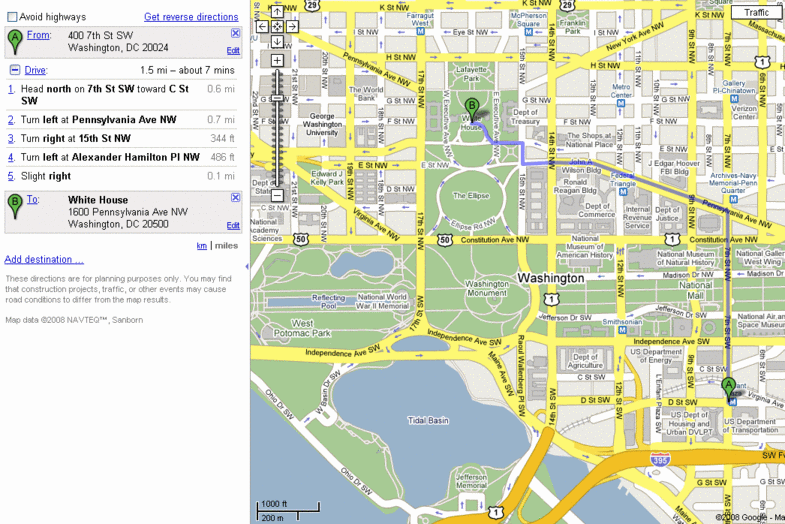
10 minutes remaining.
Mineta also explained that he talked with Richard Clarke for "4 or 5 minutes" in the White House Situation Room. We'll take the lower estimate: that's 6 minutes remaining.
He also has to make three shorter journeys: office to car, car through White House security and to the Situation Room, Situation Room to PEOC. If we allow 60 seconds for each of those (implausibly short: can anyone really check in to White House security and get into the Situation Room in a minute) then we have three minutes remaining.
And in those three minutes Mineta must react to the sight of the second crash, go to his conference room, cancel a meeting, return to his office, exchange words with Jane Garvey, talk on the phone to the CEOs of United and American Airlines, consult with his officials, and decide to go to the White House.
This seems very rushed. There are no no gaps between actions, Mineta doesn't have to wait for anything (there's no wait for his driver or security man to arrive from elsewhere in the building, say), and in addition we're assuming he's told us literally everything he did. This seems unlikely, but we have no option: there isn't time for anything else.
Still, while this may be reason to raise an eyebrow, it's not proof of anything. Especially as Mineta himself has, in other accounts, put his PEOC arrival time back as late as 9:27. That's still quick, but does provide more leeway, and we certainly can't say it's impossible for Mineta to have followed that kind of timetable.
Order of events
Mineta's recollections of times and the order of events don't always seem very accurate, particularly in this part of his Academy of Achievement interview:
Mineta says there was a "ground hold on planes going into New York" that happened at "maybe about 8:30 or 8:40 in the morning". This was before the first tower was even hit, though: the actual decision wasn't made until much later:
Mineta is giving a time for this "ground hold" that's around 30 minutes earlier than it should be.
He also appears to be saying that he delivered a "bring all the planes down" order after the Pentagon was hit, at "about 9:27". However, the Pentagon was hit at 9:37, the landing order wasn't delivered until around 9:45, and there are stories saying Mineta don't know about this until after the event (see the http://www.911myths.com/index.php/Norman_Mineta#Shoot_Down_Order Shoot Down Order] section on this page).
Some Mineta interviews show clearly inaccurate timelines, then. It's obviously wise to cross check what he's saying before you take it as fact.
Evacuating the White House
A more interesting issue is raised from Mineta's own testimony, taken from the accounts above:
When I got to the White House, it was being evacuated...
...we went over to the White House. As we went in West Executive Drive, people pouring out of the Executive Office building, people running out of the White House, and I said to my driver and security guy, "Is there something wrong with this picture? We are driving in, and everybody else is running away."
The problem here is that there's plenty of documentation that tells us when the White House was evacuated, and that occurred after the Pentagon was attacked:
Richard Clarke tells us about the evacuation decision in his book Against All Enemies:
The evacuation occurred after the Pentagon was hit, not before.
In a search for a way out of this problem, those defending the accuracy of Mineta's timeline point to this CNN report:
The White House Has Been Evacuated
Aired September 11, 2001 - 09:52 ET
THIS IS A RUSH TRANSCRIPT. THIS COPY MAY NOT BE IN ITS FINAL FORM AND MAY BE UPDATED.
THIS IS A RUSH TRANSCRIPT. THIS COPY MAY NOT BE IN ITS FINAL FORM AND MAY BE UPDATED.
We also have a report now that it was a plane that crashed into the Pentagon, and we have a large fire at the Pentagon. The Pentagon is being evacuated as we speak now. The White House had been evacuated as well.
AARON BROWN, CNN ANCHOR: CNN's John King joins us on the phone. John?
JOHN KING, CNN SENIOR WHITE HOUSE CORRESP.: Aaron, I'm standing in Lafayette Park, directly across the White House, perhaps about 200 yards away from the White House residence itself. The Secret Service has pushed most people all the way back to the other side of the park. I'm trying to avoid having that done to me at the moment.
Just moments ago they started slowing evacuating the White House about 30 minutes ago. Then, in the last five minute people have come running out of the White House and the old executive office building, which is the office building right directly across from the White House.
About 10 minutes ago, there was a white jet circling overhead. Now, you generally don't see planes in the area over the White House. That is restricted air space. No reason to believe that this jet was there for any nefarious purposes, but the Secret Service was very concerned, pointing up at the jet in the sky.
It is out of sight now, best we can tell. They've evacuated the entire White House staff and the old executive office, as well as some townhouses that are government offices. Many of our viewers might know Blair House, where other international leaders say when they are in Washington. That block of townhouses has been evacuated as well. They are pushing us now back towards 8th Street, which is the next main street to the north from Pennsylvania Avenue, across from the White House.
BROWN: John, hang on one second. We are getting reports that the Capitol, the Treasury building also being evacuated.
John, is this evacuation from the White House, was it orderly? Did it seem panicky? How would you characterize it?
KING: It started off as orderly, much like we get when there are ocassional bomb scares near the White House. But then, again in the last 10 minutes or so, the people who came out -- the last several hundred I saw leaving the grounds, were told and ordered by the Secret Service to run. They were running through the gates. These were of course professionals in business suits.
I'm also told that prior to that, and we don't know the current situation that the vice president and other administration officials on the scene very meeting in the White House situation room, which is in the basement of the White House. Whether they have stayed on the complex or not is unknown to us at this moment.
http://transcripts.cnn.com/TRANSCRIPTS/0109/11/bn.06.html(CNN report on YouTube, CNN raw footage of news crews being told to lead the White House grounds.)
Look, they say: this places the evacuation much earlier. And so it does, but there are at least three problems here.
First, there's nothing to explain how they know the White House evacuation began 30 minutes ago, around 9:22. As all other accounts place the evacuation much later, about 9:45, how can we be sure the CNN version is accurate? The idea that officials would have decided there was enough of a threat to evacuate at 9:22, but somehow ensured that evacuation lasted half on hour, makes little sense to us.
This evacuation timetable doesn't seem to be supported by the coverage elsewhere, either.
And then there's NBC.
September 11, 2001 Tuesday
SHOW: Today (7:00 AM ET) - NBC
White House evacuated; President Bush en route from Florida
ANCHORS: MATT LAUER; KATIE COURIC
BYLINE: BOB KUR
MATT LAUER, co-host:
We want to move a couple of miles away from you right now to the White House, where Bob Kur is standing by.
And, Bob, we understand that building has now been evacuated?
BOB KUR reporting:
Matt, that's true. It is utterly surreal. As soon as word came of the Pentagon incident, we were rather forcefully removed from the White House. The scene was one of administrators, cooks, whatever, running at fairly high speed all the way out of the building through the top gates. Then we huddled for a while in Lafayette Park across the street, and we've been moved now from there a block or so away. The--the offices along Jackson Place, which are across the street from the White House and adjacent to Lafayette Park, also have been evacuated. And in the most surreal of this morning's scenes here at the White house, a white plane, a very big jet, was flying an unusual pattern near the White House, over Lafayette Park, very slowly. It made one circle, and then we have not seen it since. There was a lot of concern about what that plane might be. But, again, it's only speculation, but most people say that since flights have been cleared from US airspace, and it was a totally white plane, looked unusual to all of us, that it was a government plane of some kind.
KATIE COURIC, co-host:
We should point out that we're looking at pictures, Bob, as you speak, of the World Trade Center because all of the camera crews have been evacuated from the White House as well.
When do you expect President Bush to arrive there, Bob?
KUR: Well, Katie, he's coming back directly, and you figure it's about a two-hour flight, so you--you can do the math. The reason I said it was so surreal was that within just about 20 minutes ago, they were still conducting tours. You had hordes of tourists and others still in the White House on tour, lining up outside to get in. There seemed to be absolutely no unusual activity outside the White House until word came of the incident at the Pentagon. So it's been quite a dramatic shift here.
Watch on YouTube
Bob Kur talks of an evacuation after the Pentagon was hit, with tours still being conducted at about 9:25. Are we really to believe that the White House would begin a partial evacuation around 9:22, yet still be conducting tours, while all the time a correspondent noticed nothing odd at all?
It's notable that CNN didn't seem to maintain this idea of an early evacuation. The CNN timeline "September 11: Chronology of terror", dated September 12th, says only "9:45 a.m.: The White House evacuates." And the John King, the CNN White House correspondent who mentioned the idea on the 11th, seemed to have dropped it by the afternoon of the following day:
But second, even if we accept it as literally true, the CNN story still doesn't support Mineta's 9:20 arrival at the PEOC. If he were to spend a few minutes with Clarke, then Mineta needs to be driving up at around 9:15, but the CNN story doesn't have the evacuation beginning until 9:22. That may have been an approximation, and could fit with a 9:27 arrival time, however the reporter also said the initial evacuation "started slowly", and "people have come running out of the White House and the old executive office building" only in the last five minutes. Now compare this with Mineta's description:
As we went in West Executive Drive, people pouring out of the Executive Office building, people running out of the White House, and I said to my driver and security guy, "Is there something wrong with this picture? We are driving in, and everybody else is running away."
Mineta is plainly describing the latter part of the evacuation according to CNN and Clarke, which based on this report began somewhere between 9:42 and 9:47. No-one else describes it happening any earlier, and as we've seen, NBC specifically say it was business as usual at the White House until after the Pentagon was hit.
The final issue comes at the very beginning of the CNN piece, when John King says "I'm standing in Lafayette Park, directly across the White House, perhaps about 200 yards away from the White House residence itself. The Secret Service has pushed most people all the way back to the other side of the park." NPR told us when this happened: "The evacuation--word came at 9:41 this morning everyone--staff, reporters--was moved out first into Layfayette Park and then across Layfayette Park." And here's how Mineta described what he saw when he arrived at the White House:
"Everybody" is being moved to Lafayette Park, something CNN, NPR and others describe as happening after the Pentagon was hit.
The usual excuse for Mineta, that somehow he witnessed a few people who happened to be running, clearly no longer applies here. The reality is that he described it as "everybody running out", with people coming from both the White House and the Executive Office building, and running over to Lafayette Drive: as accurate a description of the real events as you could hope within two or three sentences. Unless we're to believe this happened twice, and the press completely failed to notice the first time around, the only conclusion we can make is that Mineta arrived when the White House was being evacuated at some point after 9:40.
Delta Airlines
Norman Mineta told the 9/11 Commission that "Mr. Flaherty reported to me that Jane Garvey had phoned to report that the CEO of Delta Airlines had called the FAA and said it could not yet account for all of its aircraft." This happened before he left for the White House, and presumably refers to the scare over Delta 1989, a flight that was suspected of being hijacked on 9/11. But when did this occur?
USA Today told us:
Shortly after the second attack on the Trade Center at 9:03 a.m., FBI agents called an air traffic facility in Ohio that was tracking Flight 1989. Watch what the Delta flight does, agents told controllers at Cleveland Center.
Controllers there had already been watching.
Like the FBI, they realized that the Delta flight had taken off from Boston just minutes after American Flight 11 and United Flight 175 — the two jets that crashed into the Trade Center towers. The similarities didn't end there.
All three jets were Boeing 767s.
All were bound for Los Angeles.
All were heavy with fuel.
On this day, as Werner flies west over Pennsylvania, the similarities can't be dismissed.
Now around 9:30 a.m., controllers hear words that seem to confirm their worst fears. They hear shouting as Flight 1989 approaches the Ohio border. Then they hear a voice: "Get out of there!" Then what sounds like a scuffle.
Minutes later, a new voice, this one with a heavy accent: "Ladies and gentlemen, here it's the captain. Please sit down. Keep remaining sitting. We have a bomb aboard."
No one who hears those words believes they are coming from Werner. Not with such a heavy accent. No way. Rather, the transmission seems to be from a hijacker who unwittingly spoke over the radio when he meant to address passengers.
Officials at Cleveland Center rush word to Washington: Hijackers have another flight.
At the Federal Aviation Administration's command center in Herndon, Va., Delta Flight 1989 joins a growing list of suspicious jets. Some of their flight numbers will be scrawled on a white dry-erase board throughout the morning. Eventually, the list will grow to 11.
...
Controllers at Cleveland Center can't raise United Flight 93, a Boeing 757 flying over Ohio.
Perhaps the strange radio transmissions — the reference to a bomb and the heavy accent of a "captain" — hadn't come from the Delta flight. Maybe Capt. Werner's Flight 1989 is fine after all.
At least, that's the way it seems to the controllers. The United flight had been just 25 miles ahead of the Delta flight when the radio transmissions came through — close enough to account for the confusion.
Then, at 9:35 a.m., the United jet had climbed unexpectedly and turned back toward the Delta flight. Then...
Silence. The United flight stopped talking.
It must be United that's hijacked.
When controllers ordered Werner to change course to avoid Flight 93, he had complied quickly. Yes, Delta Flight 1989 must be fine.
But now... what's this?
The Delta flight wants to land in Cleveland? And the captain's request comes before he can know that the FAA wants every flight down. On this day, the fact that the pilot requests to be rerouted before he is ordered to land seems suspicious. Why the urgency?
Controllers don't know that Delta officials, also concerned about the flight, have ordered Werner to land in Cleveland. They continue to send messages to Werner. In code, they ask him if all is OK. Yes, he responds time and again. He doesn't know why they're so worried.
And now, preparing for landing, Werner has more important things to worry about. He was too close to Cleveland when he got the order to land. So he loops back, over Michigan, and heads toward the city.
As the jet begins its descent, another message comes through. Busy, Werner fails to respond.
On the ground, controllers in Cleveland Center grow alarmed. Why didn't he respond? Have both jets — the United and the Delta flights — been hijacked?
As a SWAT team gathers on the tarmac in Cleveland, controllers and airline dispatchers around the nation continue to contact hundreds of flights.
http://www.usatoday.com/news/sept11/2002-08-12-hijacker-daytwo_x.htm
(Read much more on the Delta 1989 page.)
A further report from the 9/11 Commission shows us that the FAA in Herndon, while concerned about Delta 1989 at 9:19, didn't appear to believe it had been hijacked.
FAA air traffic control tapes indicate that at 9:19 the FAA Air Traffic Control System Command Center in Herndon ordered controllers to send a cockpit warning to Delta 1989 because, like American 11 and United 175, it was a transcontinental flight departing Boston’s Logan Airport.
9/11 Commission Report
So when Norman Mineta told the 9/11 Commission that "Mr. Flaherty reported to me that Jane Garvey had phoned to report that the CEO of Delta Airlines had called the FAA and said it could not yet account for all of its aircraft", before Mineta left his office for the White House, we're left wondering how that could be. If Mineta were to reach the PEOC by 9:20, then the Garvey call has to arrive by around 9:12 at the latest (allowing for the travel time and his "four or five minutes" with Clarke). But the earliest reported "probable hijacking" concerns here didn't arise until 9:28. Once again, Mineta's story doesn't fit with what we know.
To defend the Mineta timetable, then, we must either theorise that there was some earlier, unreported concern on the part of Delta that caused him to receive the call from Garvey.
Or, perhaps, this was just a coincidental alert that didn't specifically relate to Delta 1989 at all.
Perhaps one of these options are true. But we're struck by the contortions, allowances and stretches that must be made to sustain the idea of Mineta's early arrival at the White House. If we drop that, accept Mineta arrived in time to witness the evacuation, just as he said himself, then these problems almost entirely fade away.
Touching History
Lynn Spencer's Touching History contains the following note about a call received by Jane Garvey on 9/11, after the Pentagon was hit:
Soon Garvey gets a call from Delta CEO Leo Mullin.
"We can't find four of our planes," he tells her. "Four of our transponders are off."
Touching History, Lynn Spencer, Page 186
If this is the call Mineta was referring to then, and Spencer's time is accurate, and Mineta received word it in his office then he can't have been at the White House before 9:20.
However, Spencer may also have Mineta in the PEOC by the time this call is received, and as her timelines aren't always completely accurate we wouldn't rely on this alone.
And fortunately, that isn't necessary. We also have Garvey's interview with the 9/11 Commission, which includes the following line:
Garvey herself only refers to a Delta issue as occurring after the Pentagon crash, while Mineta talks about receiving Delta-related information before he left the office. Yet another awkward little issue that doesn't fit with Mineta's timeline.
Shoot Down Order
Mineta told the 9/11 Commission that he believed the Cheney conversation he heard related to a shoot down order:
Mineta believes there was a shootdown order that applied when he says he was at the PEOC: from 9:20. However, the 9/11 Commission say this authorisation came much later:
The Vice President stated that he called the President to discuss the rules of engagement for the CAP. He recalled feeling that it did no good to establish the CAP unless the pilots had instructions on whether they were authorized to shoot if the plane would not divert. He said the President signed off on that concept.The President said he remembered such a conversation, and that it reminded him of when he had been an interceptor pilot. The President emphasized to us that he had authorized the shootdown of hijacked aircraft. The Vice President’s military aide told us he believed the Vice President spoke to the President just after entering the conference room, but he did not hear what they said.Rice, who entered the room shortly after the Vice President and sat next to him, remembered hearing him inform the President,“Sir, the CAPs are up. Sir, they’re going to want to know what to do.” Then she recalled hearing him say, “Yes sir.” She believed this conversation occurred a few minutes, perhaps five, after they entered the conference room. We believe this call would have taken place sometime before 10:10 to 10:15.
Chapter 1, The 9/11 Commission Report
(They then go on to point out that "there is no documentary evidence for this call", but that's a separate issue. Go read the chapter if you're interested.)
A contradiction, then, but there's an oddity in Mineta's account. He said "the president was in Florida, and I believe he was on his way to Louisiana at that point when the conversation that went on between the vice president and the president and the staff that the president had with him". By "the conversation", we assume he meant the one that led to the shootdown order, yet he also places this before 9:27. In reality Bush hadn't left the school yet, and wouldn't take off for another half hour:
Mineta appears to be placing the issuing of the shootdown order after the President was on his way to Lousiana, then, and before he heard the conversation with Cheney and the young man. But if he's right on the first part, then the conversation cannot have referred to Flight 77: it had already crashed.
The Clarke teleconference
Richard Clarke ran a video conference from the White House Situation Room on 9/11. This included representatives from the Pentagon, Joint Chiefs of Staff, Department of Defence, and more. According to Clarke's book Against All Enemies, he spoke first to Jane Garvey of the FAA, and reported: "They were frantically looking for Norman Mineta, the Secretary of Transportation... At first the FAA could not find him." Clarke reported that "Mineta called in from his car" shortly after this, so if this is correct then we have another pointer to Mineta's arrival time: at some point after Clarke's teleconference began. Here's what the 9/11 Commission had to say about that:
At the White House, the video teleconference was conducted from the Situation Room by Richard Clarke, a special assistant to the president long involved in counterterrorism. Logs indicate that it began at 9:25 and included the CIA; the FBI; the departments of State, Justice, and Defense; the FAA; and the White House shelter. The FAA and CIA joined at 9:40. The first topic addressed in the White House video teleconference—at about 9:40—was the physical security of the President, the White House, and federal agencies. Immediately thereafter it was reported that a plane had hit the Pentagon. We found no evidence that video teleconference participants had any prior information that American 77 had been hijacked and was heading directly toward Washington. Indeed, it is not clear to us that the video teleconference was fully under way before 9:37, when the Pentagon was struck.
Chapter 1, 9/11 Commission Report
If this is correct then it places Clarke's conversation with Garvey at 9:40 or after. Mineta may then have arrived about five minutes later, which would allow him to see the evacuation of the White House as he claimed. But clearly he would have been too late to hear anything about Flight 77.
Clarke is short on times in his account, and the best you can say is he places the Garvey conversation before 9:28. Others go further, saying the teleconference began at 9:10, and this is necessary for Mineta's timeline; it allows him to arrive at around 9:15, talk to Clarke and be escorted to the PEOC.
This is a large topic in itself, so we've placed it on a separate page. (Read more on the issue here). But one person, in particular, makes us question how plausible the idea of a 9:10 teleconference might be: FAA chief Jane Garvey.
Cannot find Mineta
Norman Mineta mentions FAA chief Jane Garvey in some of the accounts that we quote here.
In this version he doesn't explicitly say when Jane Garvey left. However, in the Academy of Achievement interview, this is plainly stated to be after the second World Trade Centre impact:
And in the Daily Californian interview, Mineta implies that Garvey followed him to his office after the second impact:
Mineta clearly places Jane Garvey in his conference room at 9:03, then, and possibly in his office for some time after that. She presumably then returned to the FAA, later calling with a message that Mineta receives before he leaves for the White House.
And yet, Clarke also places Garvey first in his teleconference, which some defenders of the Mineta timeline tell us happened at 9:10. And so we're supposed to believe Garvey went to Mineta's office, returned to the FAA Operations Centre, familiarised herself with the situation, and joined the teleconference in only 7 minutes? The FAA OC is only down the street (0.2 miles on Google maps), so distance isn't an issue, but it takes time to pack up, return to the office, and find out what's going on.
What's more, Clarke tells us the FAA were "frantically looking" for Norman Mineta when the teleconference began. Frantically looking for someone whom Garvey was meeting just 7 minutes ago, and had passed on a telephone message after that? This seems unlikely, and suggests to us that the Clarke-Garvey conversation took place much later.
There's supporting evidence for this in Clarke's account of the teleconference. He reports Garvey explaining that there were "reports of eleven aircraft off course of out of communications, maybe hijacked". We've not seen anyone claim that there were so many alerts at 9:10, and in fact an MSNBC report says there were "at least 10... possible hijackings" by some time after 9:38. See The Richard Clarke teleconference for more.
Order everyone to land
Mineta tells us that he made a major and significant decision on 9/11:
But there are other versions of this story. This one appeared in April 2002:
The Mineta Myth
How Bob Woodward made the secretary of transportation a false hero.
By Joshua Green
Posted Monday, April 1, 2002, at 7:02 PM ET
Among the public officials who gained folk-hero status on Sept. 11, only Rudolph Giuliani outshines Norman Mineta, who is credited with making the snap decision to ground all airborne planes shortly after the Pentagon attack. The transportation secretary was canonized in the opening paragraphs of Bob Woodward and Dan Balz's six-part Washington Post epic, "10 Days in September":
Mineta shouted into the phone to Monte Belger at the FAA: "Monte, bring all the planes down." It was an unprecedented order—there were 4,546 airplanes in the air at the time. Belger, the FAA's acting deputy administrator, amended Mineta's directive to take into account the authority vested in airline pilots. "We're bringing them down per pilot discretion," Belger told the secretary. "[Expletive] pilot discretion," Mineta yelled back. "Get those goddamn planes down."
Mineta's courageous performance has been widely praised, not least by Mineta himself in a Sept. 20 appearance before Congress, and again on 60 Minutes II a month later. Here's his congressional testimony:
I immediately called the FAA, told them to bring all the airplanes down right now. All that we have learned since that fateful morning leaves me convinced that this unusual command or order was the right thing to do.
For Mineta, the genuflection this tale has engendered has been a welcome distraction from less mythic performances, such as his department's problems getting the new airport security agency off the ground. Long considered a competent if unremarkable backbencher, Mineta has refashioned himself as a quick-thinking decision-maker with flawless instincts in an emergency.
He may be that, but he isn't the hero Woodward and Balz make him out to be. According to insiders, that honor belongs to Monte Belger, at the time the No. 2 official at the FAA. A precise, diligent career bureaucrat known among colleagues as "the Forrest Gump of the FAA," Belger was on a phone bridge with controllers at the David J. Hurley Air Traffic Control System Command Center in Herndon, Va., and ordered flights grounded 15 minutes before Mineta was even notified of the attacks. So, when the secretary issued his blunt order—"Monte, bring all the planes down!"—Monte had already done so.
FAA officials and beat reporters have known this for months. "Any clued-in transportation reporter knows what went on that day," says one. But Mineta apparently does not. After he gave his congressional testimony, FAA officials, including Belger, who is a consummate team player, kept quiet in deference to their boss. Though beat reporters knew the truth as long ago as November, none came forward for fear of being frozen out.
Until last Tuesday, when, at the end of a speech before the Aero Club of Washington, D.C., the Washington Post's veteran transportation reporter Don Phillips let the cat out of the bag. Phillips told his audience he felt it necessary to make a "historical correction," although FAA officials had begged him to maintain the fiction. Phillips proposed, charitably, that Mineta's order was a simple misunderstanding; that the secretary was unaware that "[f]or at least 15 minutes before Mineta's conversation with the FAA, controllers were bringing the planes down ... at the nearest airport." Phillips continued:
I'm told by very high sources that it happened this way: First, the decision was made on a regional basis by some gutsy local FAA officials, and the FAA command center and headquarters officials agreed that it should be spread to the whole country. First, [the FAA] acted. Then they sought permission. A top FAA official ... then called Mineta, finding him in a bunker with the vice president and other officials. He explained the plan, and Mineta agreed. ...
Then there was a pause in the conversation. You know what many of us do when there is a pause in the conversation. We try to fill the dead time. The FAA official, unfortunately said something like, "Of course we could have let them go on to their destinations, or ..." Big mistake. Norm heard that throwaway line as saying the FAA was still considering letting them go on to destination. He then fired off his now-famous order.
All this raises the question of why, if every reporter on the transportation beat knew the truth about Mineta's command, Woodward and Balz got it wrong. It's plausible that Mineta really didn't know the truth about Sept. 11—that due to his deputies' protectiveness, the secretary has been unwittingly repeating an erroneous version of events.
But that doesn't excuse Woodward and Balz. Unlike so many other juicy Woodward anecdotes, this one was easily verifiable, particularly since their Post colleague, Phillips, had ferreted out the truth. "I have no reason to doubt that the more complicated version that [Phillips] explains is probably the accurate one," Balz says.
Woodward isn't nearly as ready to concede. "This is the first I've heard of it," he told me, adding that he checked his version of the story with Mineta's staff. "If I'd known of that information—and it was correct—I probably would have included [the anecdote]. But no correction is necessary. What we wrote is not inaccurate." Not inaccurate, perhaps—but not exactly accurate either.
http://www.slate.com/?id=2063935This story says the "everybody land" decision was made by the FAA at 9:45, without consulting with Mineta, who was only informed of the decision when an FAA official called him. How is this possible, if Mineta had established phone bridges with Belger and Garvey on a 9:20 arrival at the PEOC?
It's true that this article makes an obvious error in saying that Mineta was informed of the order before he even knew of the attacks, and that doesn't help it's credibility. We also don't have a named source for the FAA side of things. There's some support for this version of events in a 2002 USA Today story, though:
For the last 30 minutes, since the second Trade Center tower was hit, [Ben] Sliney has considered bringing every flight down. Now, the manager in charge of the nation's air traffic system is certain.
He has no time to consult with FAA officials in Washington.
The skies are filled with guided missiles, he thinks. Filled with them. The words he cannot shake have proved true. The hijackers did have more planes.
"Order everyone to land! Regardless of destination!" Sliney shouts.
Twenty feet away, his boss, Linda Schuessler, simply nods. She had organized the command center earlier that day, trying to create order from the chaos so Sliney could focus on what had to be done.
"OK, let's get them on the ground!" Sliney booms.
Within seconds, specialists pass the order on to facilities across the country. For the first time in history, the government has ordered every commercial and private plane from the sky.
9:45 a.m.: 3,949 planes
A misunderstanding
In Washington, FAA Administrator Jane Garvey and her deputy, Monte Belger, have been moving back and forth between a secret operations center and their offices.
Throughout the morning, staffers have kept Garvey and Belger apprised of Sliney's decisions.
Now, they tell them of the order to clear the skies. With little discussion, the FAA leaders approve.
Minutes later, Transportation Secretary Norman Mineta calls from a bunker beneath the White House, where he has joined Vice President Cheney. Belger explains that the FAA plans to land each plane at the closest airport, regardless of its destination.
Mineta concurs. FAA staffers, following the conversation over the speakerphone with Belger, pump their fists. Then the conversation sours.
Mineta asks exactly what the order means.
Belger says pilots will retain some discretion. All the FAA deputy means is that under long-standing aviation regulations, pilots always have some discretion in the event of an emergency aboard their aircraft. But the secretary assumes the FAA is not being tough enough. "F—- pilot discretion," Mineta says. "Monte, bring down all the planes."
http://www.usatoday.com/news/sept11/2002-08-12-clearskies_x.htm
According to this version, Ben Sliney made the actual decision. Garvey and Belger approved. They were then called "minutes later" by Mineta, more support for the idea that he's establishing the phone bridge after the White House was evacuated at 9:45, and not at 9:20. And this account then has Mineta misunderstanding what's happened, and presumably feeling like he's issuing a tougher order than the FAA, perhaps the reason why he continued to take the credit.
Sliney and Belger told a similar story about how the order originated to the 9/11 Commission:
MR. FARMER: ... The Command Center's national operations manager, Ben Sliney ordered all FAA facilities to instruct all airborne aircraft to land at the nearest airport. This was a totally unprecedented order. The air traffic control system handled it with great skill, as about 4,500 commercial and general-aviation aircraft soon landed without incident...
MR. GORTON: Okay. Let me go on to you, Mr. Sliney, with a few questions. When you on your first day on the job made two decisions on 9/11, that at one level at least weren't yours to make, did you not? First, that no one should take off; and, second, we should take all civilian aircraft out of the air. Is that not correct?
MR. SLINEY: That is correct.
MR. GORTON: And would you describe how you came to that decision and why you felt it imperative enough to make that decision without going through the usual command structure?
MR. SLINEY: I believed I had the authority to do those things on that day. I was charged with the safe and efficient operation of the national airspace system. The ground stop -- the national ground stop was, one, a matter of scope, not of unfamiliarity with the remedy, but a matter of scope. And had -- since we had already put in place ground stops that covered Boston, New York, and essentially the East Coast, and those -- we still had more reports of aircraft whose course or altitude or other aspects of their flight made them suspicious in light of the crashes. The national ground stop was just a natural extension of the smaller scope ground stops.
As to the order to land, that was the product of the men and women in the Command Center who gave me advice on that day, the supervisors and the specialists. We were searching for something more to do, and that was made and decided on, and the impetus for that of course was the crash into the Pentagon when we gave that order.
MR. GORTON: Was your career in the FAA either enhanced or hurt in any way by making those decisions as promptly as you did?
MR. SLINEY: I would say in neither respect, sir.
...
MR. GORTON: It wasn't the formal protocol for Mr. Sliney to have gotten headquarters permission before he put in these ground stops?
MR. BELGER: I don't agree with that personally. I think -- I agree with Mr. Sliney completely. I think they had the authority to make that decision. I think they made the right call.
MR. GORTON: No question about that.
MR. BELGER: They make those -- not into scope obviously -- but they make ground-stop type decisions on a daily basis. And I think the folks there, the folks in Boston, the folks in the facilities -- and frankly at the same time that the people in the Department of Transportation were coming to that same conclusion, at the same time they all made the right decision.
MR. GORTON: So no one criticized Mr. Sliney for having made it without getting permission from headquarters?
MR. BELGER: I never criticized him. Absolutely not. To the contrary.
MR. GORTON: That's not quite the answer to my question. Do you know whether anyone else did?
MR. BELGER: I don't know.
MR. GORTON: Mr. Sliney?
MR. SLINEY: I only -- I was not criticized directly by anyone for making that decision at all. I say that unequivocally. I could say I heard anecdotal information that someone was surprised that we had made that decision, but that was the extent of it. No one has criticized me directly for doing either of those -- making either of those decisions.
http://govinfo.library.unt.edu/911/archive/hearing12/9-11Commission_Hearing_2004-06-17.pdf
(We've snipped everything but the ground stop decisions, but Sliney and Belger had plenty of other interesting things to say. If you've not read their testimony before, then go rectify that now.)
And in a private Commission interview, Sliney said the FAA tried to persuade him to go along with the idea that Mineta ordered the planes down, even though this was "a fiction":
It seems that Mineta's account of delivering the ground stop order does not prove that he was in the PEOC before 9:45, then. The USA Today story in particular, talking about Mineta contacting the FAA after the "land everyone" order had been issued, makes a good case that he didn't arrive until later. And Sliney's account is evidence that the FAA may have tried to cover this up.
Monte Belger and Jane Garvey
As we've seen, Mineta claims that he arrived at the PEOC before the Pentagon was hit, and established phone contact with Monte Belger at the FAA, who then reported the position of the approaching Flight 77 in the minutes before it hit the building. But what does Belger himself say about this? A couple of Commission interviews tell us more.
The "around 9:45" would seem to support Mineta in terms of the ground stop order.
However, Belger says nothing about monitoring the plane as it approached, or talking to Mineta just before the crash; rather, they only "got on the phone with Norm Mineta" after they heard of what had happened.
The second interview is fractionally more detailed:
Here Belger makes it clear that he didn't recall speaking with Mineta about the "high speed VFR". And there's no reference to discussing any similar incident with Mineta, either. Has Belger forgotten tracking Flight 77 in its final moments - or is there another explanation for Mineta's story?
Perhaps Jane Garvey's interview can tell us more.
There are several interesting points here.
Garvey tells the Commission that she leaves Mineta's office before the second tower was hit, for instance, while Mineta clearly says this was afterwards. Is Garvey revising her account to make it look like she responded more quickly, or is Mineta mistaken? We don't know.
There's confirmation here that the concerns over possibly missing Delta flights didn't arise until after the Pentagon was hit, yet Mineta appears to say that he heard about these before he left the office.
Garvey talks of feeling that "they needed to get the Secretary more into the decision-making loop", suggesting there was some notable period when he wasn't significantly involved.
And Mineta called and gave his order to "bring all of the planes down" only "after the fourth crash".
Putting it all together, then, there's no support here for Belger communicating the final moments of Flight 77 directly to Mineta in the PEOC. And while they vary on the detail, both Belger and Garvey talk of getting in touch with Mineta only after hearing of the Pentagon crash, and not at around 9:20, as he claims.
No other witnesses
We've seen the accounts of an incident similar to the one that Mineta describes, where an official repeatedly warns Cheney of an incoming plane, and is given a shootdown order. Mineta says something like this happened before the Pentagon was hit, but the uncomfortable truth is that everyone else places it afterwards.
We're not simply talking about Cheney or Libby, either. David Bohrer, the White House photographer regarded as reliable enough to use as a witness for placing Cheney in the bunker early, said this to ABC News:
04:21:55 CHARLES GIBSON, ABC NEWS
(VO) Cheney personally compiles a list of possible threats from the air.
04:21:58 CHARLES GIBSON, ABC NEWS (CONTINUED)
(OC) Of the flights that you didn't know where they were?
04:22:02 VICE PRESIDENT DICK CHENEY, UNITED STATES
That we couldn't account for.
04:22:04 DAVID BOHRER, WHITE HOUSE PHOTOGRAPHER
At first it was one of a few planes that they had questions about.
04:22:07 CHARLES GIBSON, ABC NEWS
(VO) White House photographer David Bohrer watches the tense moment and records it on film.
04:22:13 DAVID BOHRER, WHITE HOUSE PHOTOGRAPHER
Eventually it narrowed to Flight 93. That was the biggest threat at that point.
04:22:19 KARL ROVE, WHITE HOUSE COUNSELOR
If you take the trajectory of the plane, of Flight 93 after it passes Pittsburgh and draw a straight line, it's gonna go to Washington, DC.
04:22:27 NORMAN MINETA, TRANSPORTATION SECRETARY
You just had to do something instantaneously.
04:22:30 DAVID BOHRER, WHITE HOUSE PHOTOGRAPHER
There was a, a PEOC staffer who would keep coming in with updates on Flight 93's progress towards DC.
04:22:40 CHARLES GIBSON, ABC NEWS
(OC) Did you have any thoughts at the time as to what the target of that airplane might be?
04:22:44 VICE PRESIDENT DICK CHENEY, UNITED STATES
I thought probably White House or Capitol. We found out later from interviewing people who were detained Al Qaeda members, that said the fourth plane was intended for the White House.
04:22:55 BRIGADIER GENERAL W MONTAGUE WINFIELD, US ARMY
The decision was made to try to go intercept Flight 93.
04:22:59 VICE PRESIDENT DICK CHENEY, UNITED STATES
The significance of saying to a pilot that you are authorized to shoot down that plane full of Americans, is a, you know, it's an order that had never been given before.
04:23:10 ANDREW CARD, WHITE HOUSE CHIEF OF STAFF
Very, very tough decision. And the President understood the magnitude of that decision.
04:23:30 CONDOLEEZZA RICE, NATIONAL SECURITY ADVISER
The President did give the order to shoot down a civilian plane, if it was not responding properly. And it was authority requested through channels, by Secretary Rumsfeld, Vice President passed the request, the President said, "yes."
04:23:32 DONALD RUMSFELD, SECRETARY OF DEFENSE
It was a totally different circumstance for our country, the thought of having to shoot down one of our own civilian aircraft.
04:23:40 CHARLES GIBSON, ABC NEWS
(OC) Do you remember your own thoughts as to what you were thinking?
04:23:43 VICE PRESIDENT DICK CHENEY, UNITED STATES
Yeah, that this was a very difficult, difficult proposition, but it had to be done. If we had been able to intercept the planes before they hit the World Trade Center, would we? And the answer was, absolutely yes.
04:23:55 DAVID BOHRER, WHITE HOUSE PHOTOGRAPHER
And the President gave the, the VP authority to make that call. It was a chilling moment, chilling moment.
http://911research.wtc7.net/cache/pentagon/attack/abcnews091102_jenningsinterviews.html
Bohrer talks of a staffer repeatedly returning with warnings of an incoming plane, thought to be Flight 93. He does not say "strangely, this also happened just before the Pentagon was hit". (The programme does also cover Mineta's story as though it were Flight 77, but Bohrer doesn't comment on that. Follow the link to read the whole thing, if you haven't already.)
Similarly, Richard Clarke in the Situation Room only reports Ralph Siegler telling him of an incoming "hostile aircraft" after the Pentagon was hit, not before. (Although it's worth noting that Condoleezza Rice aide Franklin Miller, also in the Situation Room that day, says he doesn't recall those warnings happening at all.)
We've yet to see any record of another witness mentioning Cheney's order prior to the Pentagon being hit, then, or even just commenting on how the post-10:00 warnings weren't the first that had been received that day. Even witnesses happily quoted by David Ray Griffin on other issues, like Clarke and Bohrer, don't confirm his story here. What does that tell you? Is everyone else lying, or is Mineta just wrong?
Dana Hyde memo
Dana Hyde was a 9/11 Commission member who spent a great deal of time pursuing White House and FAA officials, in an attempt to put together a timetable for the day. And in a memo she reveals when logs say Mineta arrived at the WTC. 10:07:
 Source
Hyde wonders about the accuracy of these logs, which is something that defenders of the Mineta timeline will seize upon. But as the Commission accepted a time of 9:58, it seems reasonable to suggest they wouldn't argue with the 10:07 time for Mineta, either. And as we've seen, this log isn't out of place: it matches up with other evidence that suggests Mineta arrived at the PEOC far, far later than 9:20.
Common objections
As we've seen, a 9:20 arrival at the White House would be difficult for Mineta to achieve. His description of people running from the White House fits the scene at 9:45, not 9:15. There are further issues with Delta 1989 and the timing of the shoot down order, while Richard Clarke's teleconference also suggests Mineta arrived later than he claimed. And it's reported that Mineta knew nothing of the FAA decision to ground all planes until some minutes after this had been issued. All these problems are resolved if we shift his timeline forward, but in that case the Cheney conversation Mineta overheard cannot have referred to Flight 77, and it's not evidence for a stand-down.
This isn't enough for some, though. "Ah," they say, "but what about..."
Clarke and the Mineta arrival
David Ray Griffin discusses this issue in his book 9/11 Contradictions. He claims that Richard Clarke tells us when Mineta arrives: "at about 9:15, Norman Mineta arrived". Here's what Clarke actually said, starting as he's talking to Jane Garvey during the teleconference:
On an accuracy note, there are reasons to question some of what Richard Clarke says. Mineta does not have "two sons who were pilots for United", for instance. They flew with Horizon Airlines and Delta Airlines. And although Clarke says he spoke to Richard Myers at 9:28, Myers said he was in a meeting with Senator Max Cleland at the time ([Cleland backs him up]).
More seriously, it's plain from the text that Clarke is not unambiguously saying that Mineta has arrived at this point. He could have delivered all both statements on the phone: "please come to the Situation Room first and I'll brief you on what's going on, but after that I think it's best if you join the Vice President". We might say that's less likely, as Clarke doesn't mention Mineta again, but then this is becoming horribly imprecise (on the Mineta arrival here). And this can in no way invalidate the arguments we've made earlier, especially as Richard Clarke's account has so many problems of its own.
Clear the Skies
In 9/11 Contradictions David Ray Griffin claims the following support for Mineta's story:
Mineta's account was also supported by a BBC program entitled "Clear the Skies," which aired in September 2002. This program, after telling of Cheney's being rushed to the underground bunker, showed Mineta telling the story about the young man asking Cheney, prior to the Pentagon strike, if the orders about the incoming plane still stood.
9/11 Contradictions, David Ray Griffin
We found the transcript of this programme online, though, and if accurate this doesn't present nearly such a clear-cut picture (something that Griffin appears to concede in a later section of the book):
09:33:00
Compton: 'It was a mad-dash motorcade out to the airport.'
Dowd: 'The Secret Service agents all had weapon barrels that were visible and they were pointing up at the ready position in case they needed to be used.'
On the radar screens an Air Traffic Controller spots an unidentified blip. It's a plane with its transponder turned off and its heading straight for Washington DC. It's flying low at 800 kilometres per hour. Air Traffic Control immediately warns the Secret Service.
Gavin Hewitt, BBC presenter: 'Here at the White House, Secret Service agents rushed into the Vice President's office. Sir, they said, we have to leave immediately. Before he could respond they grabbed him under the arms,
practically lifting the Vice President off the ground. They took him to the White House basement, along a tunnel, to an underground bunker.'
Vice President Dick Cheney, now secure, takes charge (at the Presidential Emergency Operations Centre). One of those who joined the Vice President there was his wife Lynne Cheney.
Lynne Cheney: 'My husband had talked to the President and they decided that the thing to do if the airline continued to approach was to shoot it down. That was one of the more horrific moments I can remember.'
Eckmann: 'They said - all aeroplanes, if you come within (I believe it was) 30 miles of Washington DC, you will be shot down.'
Also in the bunker Norman Mineta. He was talking to the Federal Aviation Administration as a suspect plane approached the capital.
Norman Mineta, Secretary of Transportation: 'The young man said to the Vice President - 'The plane's ten miles out. Do the orders still stand?' - and the Vice President whipped his head around and said of course they do.'
Some fears turned out to be unfounded but one threat quickly became real.
Unidentified pilot: '... American Airlines plane headed east over the Pike towards the Pentagon.'
Mike Walter, CNN correspondent: 'I heard the roar of the engine. I rolled down the window. I looked up, I saw the jet banking and could clearly you could see the AA on the side, I knew it was an American Airlines jet and it went into a steep decline & accelerated.'
[Security camera footage of plane hitting the Pentagon]
Voice on police radio: 'We've just had an aeroplane crash, Eastern area, what appears to be the district area.'
(Source)
The programme does repeat Mineta's story, then. But it also says Cheney wasn't evacuated until after 9:33, contradicting Mineta's claim that he was in the PEOC at 9:20/ 9:27, and meaning Cheney would arrive too late to take part in any "50 miles out" conversation. Which version is true? "Clear the Skies" provides no additional information to help us find out, and therefore cannot be seen as delivering real support for either account.
Cheney at the PEOC
A key part of the Mineta story is that Cheney was in the PEOC at 9:20 (or 9:27, depending on the account you choose). David Ray Griffin tells us that "His story, however, is in line with that of many other witnesses (source), and so defenders of the Mineta timeline are quick to point to these other witnesses as support for his story.
Take a closer look at these witnesses, though, and it turns out their stories don't offer nearly as much support as we're frequently being told. In fact, they don't stand up to scrutiny at all (read the full details here).
And that's a problem, because this issue is critical to the Mineta timeline. If Cheney only arrived in the shelter immediately before the PEOC at 9:37, then the Mineta account must be false.
Bob Woodward
9/11 activist George Washington reports on "additional confirmation" of Mineta's story:
However, there's nothing here to say that Woodward is doing anything other than repeating Mineta's story, which was already in the public domain. He certainly provides no evidence that it's been independently corroborated. Further, when you look at the full text you find a significant contradiction:
9:32 a.m.
The Vice President in Washington: Underground, in Touch With Bush
Secret Service agents burst into Cheney's West Wing office. "Sir," one said, "we have to leave immediately." Radar showed an airplane barreling toward the White House.
Before Cheney could respond, the agents grabbed the vice president under his arms-nearly lifting him off the ground-and propelled him down the steps into the White House basement and through a long tunnel that led to the underground bunker.
Meanwhile, American Airlines Flight 77, a Boeing 757 that had taken off from Dulles International Airport, turned away from the White House and flew back across the Potomac River, slamming into the Pentagon at 9:39 a.m.
In the tunnel below the White House, Cheney stopped to watch a television showing the smoke billowing out of the World Trade Center towers, heard the report about the plane hitting the Pentagon and called Bush again. Other Secret Service agents hustled Rice and several other senior White House officials included in an emergency contingency plan into the bunker with the vice president.
Transportation Secretary Norman Y. Mineta, summoned by the White House to the bunker, was on an open line to the Federal Aviation Administration operations center, monitoring Flight 77 as it hurtled toward Washington, with radar tracks coming every seven seconds. Reports came that the plane was 50 miles out, 30 miles out, 10 miles out-until word reached the bunker that there had been an explosion at the Pentagon.
Mineta shouted into the phone to Monte Belger at the FAA: "Monte, bring all the planes down." It was an unprecedented order-there were 4,546 airplanes in the air at the time. Belger, the FAA's acting deputy administrator, amended Mineta's directive to take into account the authority vested in airline pilots. "We're bringing them down per pilot discretion," Belger told the secretary.
"[Expletive] pilot discretion," Mineta yelled back. "Get those goddamn planes down."
Sitting at the other end of the table, Cheney snapped his head up, looked squarely at Mineta and nodded in agreement.
Originally at
www.washingtonpost.com/ac2/wp-dyn/A42754-2002Jan26, now dead
Just as with with Clear the Skies, the Woodward piece doesn't place Cheney in the PEOC tunnel until after 9:32, too late to play a part in the "do the orders still stand?" conversation described by Mineta, at least if it related to Flight 77. This account may repeat Mineta's version of events, then, but other parts of the story contradict, rather than corroborate it.
50 miles out
Some people have tested Mineta's account by trying to compare his times and distances with the approaching Flight 77. The NTSB said Flight 77 was 38 miles out from the Pentagon at 9:29, for instance, so you could say it was around 50 miles out at 9:26, more or less as Mineta said.
There are complications here, though. Mineta reported hearing that the plane was "50 miles out", but from what? Unless it's believed that whoever was feeding the distances knew the Pentagon was a target, then the chances are they were referring to something else.
Let's suppose someone discovers this, and finds a new time: it's still possible to construct a case that makes Mineta look good. Mineta has said he reached the PEOC by 9:20 and 9:27 in the interviews above, 9:25 in a video interview, and in turn gave a two minute window for the time he overheard the conversation with Cheney. If we were to allow Mineta a further 1 minute margin of error either side of that window, then we could say he's scored a hit if Flight 77 were 50 miles out (from wherever) at 9:24-9:27 or 9:29-9:34. That's a substantial 10 minute range, more than half the time available between Mineta's supposed 9:20 arrival and the Pentagon being hit, so the odds are actually in favour of one of these accounts fitting the Flight 77 timetable.
The reality here is that these calculations depend on "9:20" and "5 or 6 minutes" being reliable figures, and that's most unlikely to be true. Mineta almost certainly didn't arrive at 9:20:00 precisely, didn't look at his watch to make sure, but instead worked back later to come up with an approximate figure that he rounded off to the nearest minute or two. It's what everybody does, and even without his other arrival times we wouldn't be placing too much reliance on this one.
But of course we do have the other arrival times, and all the other problems with Mineta's testimony, and they won't go away just because of the result of a calculation like this. Supporters of the Mineta timetable can at best argue it shows the movements of Flight 77 may be consistent with his story, but that's about it.
Flight 93 never 10 miles out
Another argument we hear is that Flight 93 never got remotely close to being "10 miles out", therefore it cannot have been the plane mentioned in the conversation Mineta overheard. The 9/11 Commission Report made an attempt to address this by talking of a projected flight path only:
At 10:02, the communicators in the shelter began receiving reports from the Secret Service of an inbound aircraft—presumably hijacked—heading toward Washington. That aircraft was United 93. The Secret Service was getting this information directly from the FAA. The FAA may have been tracking the progress of United 93 on a display that showed its projected path to Washington, not its actual radar return. Thus, the Secret Service was relying on projections and was not aware the plane was already down in Pennsylvania.
9/11 Commission Report
The Commission also doesn't talk of the flight being "10 miles out", instead talking of 60 miles out at between 10:12 and 10:18. This could match up with a projected Flight 93, though, and there's confirmation from elsewhere of concerns about planes approaching after the Pentagon was hit. This story talks of a plane "basically coming down the [Potomac] River, perhaps matching Mineta's description:
The Arlington County after-action report also reported that Flight 93 was thought to be in the air, long after it had crashed:
And there were other alerts, including this one also referring to "a couple [of] unknowns heading north on the Potomac River toward the White House":
It's still a little frustrating that the Commission only say the FAA "may" have been using a projected path, but pilot and author Lynn Spencer has provided some independent confirmation (our emphasis):
And History Commons have also provided further details in a timeline entry 9:56 a.m. September 11, 2001: Air Traffic Controller Changes Flight 93’s Destination to Washington.
In the meantime, though, this question doesn't help the Mineta timeline much. If the plane mentioned in the conversation Mineta overheard was not Flight 93, it could be something else, and no amount of looking into this issue will make the problems surrounding his story go away.
Mineta cannot be that wrong
Another Mineta defence is that he simply "couldn't be that wrong", there's too much detail in what he says. How could he be that confused?
Well, as we've seen already, he has been substantially wrong in the past when talking about times:
The local ground stops didn't occur until after 9:00, some 20-30 minutes later than Mineta was saying here. And the full ground stop didn't happen until 9:45, not 9:27. These are not small errors.
In reality, though, this is a secondary question. The key issue here is whether Mineta's story is true, or false. We believe information already in the public domain shows his story is inaccurate. Figuring out why it's inaccurate is another question entirely. We could speculate, research examples showing the fallibility of memory and how unreliable witnesses can be, but that wouldn't prove anything. The "why" question simply isn't one that long-distance Internet researchers can usefully address.
Of course there is an explanation commonly used by 9/11 researchers, when they spot an apparent anomaly in someone's story: they say that individual is lying. However you'll only rarely hear that in connection with Mineta. His story is defended to the end, with all anomalies excused, and we believe for one reason only: it's required to implicate Cheney.
Mineta confirmed his testimony in 2007
Mineta was asked about his testimony in a 2007 video:
We're not entirely sure what this is supposed to prove, however. Yes, Mineta has said he's standing by his account: that's no surprise, it's the same story he's been telling since shortly after the attacks. But that doesn't make his account correct, nor does it get rid of the many problems with his timetable of events. In fact, the video introduces a new problem in the idea that "Lynn Cheney was also in the PEOC bunker already at the time of his arrival". The 9/11 Commission put her arrival at 9:52, something that fits with earlier accounts in the media:
November 9, 2001, Newsweek interview
Q Well, let's go, if we can, then, to the morning that it happened. Tell me where you were and what you were doing as this event happened.
MRS. CHENEY: I was downtown. And the Secret Service let me know when one plane had hit, and when the second
plane went in. But when the Pentagon was hit, they decided I should be out of downtown, and moved me rather briskly into a car, which went at rather high speed toward the Vice President's house.
When we got partway there, a decision was made -- and I don't know why or how -- that, no, the right thing for me-to do was not go to the Vice President's house, but to go to the White House and to go down into the bunker.
And so we made a rather dramatic U-turn in the middle of the street and headed toward the White House. I can
remember that I could see smoke. And I was feeling somewhat alarmed because I thought the smoke -- even though it was from the Pentagon and I knew the Pentagon had been hit -- it sure looked to me like the smoke was coming from the White House.
When we got there, I arrived just as the White House was being evacuated. So the guards had no idea who we were and were confused that somebody would want to be coming in, and wouldn't lower the barriers. The Secret Service people who were with me drove onto the sidewalk. And at that point, a fire engine tried to block our way --
Q Wow. _
MRS. CHENEY: -- going into the White House. But I finally got in, was taken downstairs -- and as I say,
everybody else was leaving the White House at this point -- lower and lower into the White House, and came across Dick, who was already underground. And when I got there, he was on the phone with the President. He was on the phone with the President many times that day. But from that first place where I ran into him, I moved with him into what they call the PEOC -- what is that, the President Emergency -- I don't know what the initials stand for, but you probably do.
Q Right. So when you met up with him, he wasn't already in the PEOC?
MRS. CHENEY: No, he was not. He was in a secure location; it was not the PEOC, but on his way there.
Source - 2001 Newsweek interview
CNN
February 19, 2002 Tuesday
SHOW: CNN LARRY KING LIVE 21:00
Interview with Lynne Cheney
GUESTS: Lynne Cheney, Bob Schieffer, Hugh Downs
BYLINE: Larry King
SECTION: News; Domestic
KING: Where were you at that moment, that morning?
CHENEY: I was downtown. And --
KING: Washington, D.C.?
CHENEY: In Washington, D.C. And the first plane went in, and like everyone else, I thought and the security people with me thought that it was an accident.
KING: Where were you, in an office?
CHENEY: Oh, Larry, I've been trying to avoid that. I was getting my hair done. I mean, I hate to have been doing something so trivial at such an awful moment, but that's the truth.
KING: Was there a television there at that place?
CHENEY: There was a television. And then the second plane went in. And it was clear we were now in a time of crisis. And so the security people took me out at a very rapid pace, and we headed first for the vice president's house, going very fast. And then, the plane hit the Pentagon, and as I've tried to reconstruct it later, I think that we were heading for the vice president's house, because downtown Washington was considered a danger zone.
When the plane went into the Pentagon, then it was decided the best place for me would be in the bunker at the White House. So we did a rather dramatic u-turn, headed back to the White House where they wouldn't let us in. Everyone else was being evacuated. And I thought -- I think they thought some sort of crazy person was trying to come in at that point. The very smart security people I was with, drove up on the sidewalk, a fire engine immediately blocked our path. They didn't want us in, but finally we got in.
And I spent that day down in the Emergency Operations Center, the president's center down under the White House...
There's a small issue here in Dick Cheney supposedly hearing about the Pentagon attack just before his wife arrived at 9:52; he said he heard just after arriving in the PEOC conference room, which the 9/11 Commission placed at around 9:58.
However, in terms of Lynne Cheney herself, all the accounts we've found say she didn't arrive until after the Pentagon was hit. If these are true, and Lynne Cheney was indeed in the PEOC when Mineta arrived, then the conversation he overheard could not have related to Flight 77.
Security Service Timeline
A recently released Secret Service timeline has been quoted in support of Mineta's claims.
The document tells us that the Secret Service were informed of a plane en route to the Washington area at 9:18, for instance. White House evacuation was initiated at 9:26; Cheney was in the PEOC tunnel at 9:30, and in the PEOC at 9:33 (source, page 6/18 in the PDF).
Of course if Cheney wasn't in the PEOC until 9:33, then Mineta couldn't have seen him there at 9:20 (or even 9:27), so how much support the document offers is open to question. Still, this does place the evacuation far earlier than other reports, so at first glance it may seem compelling. Until you look at the other documents contained within the file, that is, which turn out to contradict Mineta's version of events in several ways.
Page 4, for instance, talks of a phone call to Secret Service agent Truscott at 9:43, warning of an approaching aircraft and saying that the White House was being evacuated. Or evacuation may have followed afterwards, as it mentions Truscott initiating the evacuation; either way, it's hard to see how the Special Agent In Charge wouldn't hear about an evacuation until some 17 minutes after it had begun. And it fits very well with the idea that the evacuation didn't occur until around 9:45.
On page #5 Truscott talks of meeting Cheney in the tunnel, where he was on the phone, and advising him to move to the PEOC proper. And Truscott also says that "the report of the Pentagon being hit by the suspicious aircraft was announced to the VP and NSA Rice after they arrived at the PEOC", matching up with what Cheney has said.
Page #8 confirms Lynne Cheney's account of events, saying she only arrived at the PEOC after the Pentagon was hit (Mineta has said she was there when he arrived), and contains a note saying that the White House was being evacuated when she arrived.
Page #9 and #12 contain security service reports describing when and why Cheney was evacuated: some time after 9:30, when there was a report of an incoming plane (a match for the 9/11 Commission's timeline, but contradictory to Mineta's). Are we to believe that the White House was evacuated before Cheney was moved?
Page #13 has a timeline stating that Author (Lynne Cheney's codename) and Angler (Dick Cheney) were only "moved to relocation site at White House" at 9:55pm. (However, it also says "Plane crashed into Pentagon" at 9:50, showing you can't rely on these documents for very accurate timings.)
Page #14 has a timeline talking of Angler being moved to "secure location" earlier, at 9:36, which would fit with his initial relocation to the PEOC tunnel.
And there are assorted other pages repeating very similar information.
So: there is one page here that places the White House evacuation much earlier than normally claimed. It's not early enough to work for Mineta's 9:20 arrival time at the PEOC, though. And other pages contradict this, talking of Truscott initiating the evacuation far later, Cheney not being evacuated until after 9:30, Lynne Cheney not arriving at the PEOC until much later still, all in direct opposition to Mineta's claim of seeing them both in the bunker at 9:20.
Of course some people will ignore this, quote selectively from the document and hope no-one will bother to check. But the reality is that most of these pages contradict Mineta in various ways: please, go read the whole thing, find out for yourself.
Conclusion
The Mineta story is often presented as though it's clear and definitive fact, but as we've seen, if you take a close look at the details then major problems emerge.
- Mineta said that when he arrived people were "pouring out of the Executive Office building", "running out of the White House" and "running over towards Lafayette Park". This is a very accurate description of what happened after the Pentagon was hit, and precisely no-one describes it happening any earlier. It's clear evidence that Mineta arrived after the Pentagon was hit.
- Mineta said that, before he left for the White House, "Jane Garvey had phoned to report that the CEO of Delta Airlines had called the FAA and said it could not yet account for all of its aircraft". Mineta places the event well before 9:20, then, yet Garvey only mentions issues with Delta planes as occurring after the Pentagon was hit.
- Richard Clarke tells us Mineta wasn't at the White House when his teleconference begins. He puts this well before 9:28 in his book, but the content says it must have been later, most probably after the Pentagon was hit.
- At least two media reports tell us that Mineta did not give the 9:45 ground stop order, and that he wasn't in contact with the FAA until some minutes later. This doesn't fit with his claims of a 9:20 PEOC arrival - it would mean he took 30 minutes or more to call the FAA - but makes sense if he did arrive after the Pentagon was hit.
- Ben Sliney, the man who gave the ground stop order, said his recollection of events was different to Mineta's and Garvey's, yet an FAA official tried to persuade him support the story that Mineta ordered the ground stop, something he said would be to "go along with a fiction".
- Mineta reportedly said that Lynn Cheney was in the PEOC when he arrived. The 9/11 Commission place her arrival at 9:52, though, and since 2001 she's consistently said she arrived after the Pentagon was hit. Another indication that Mineta did, too.
- Dana Hyde's mention of the PEOC shelter log said Mineta didn't arrive until 10:07.
- Mineta says Monte Belger provided positional information on Flight 77 as it approached the Pentagon. Belger's interviews contain no reference to any such incident, though, and only talk about getting on the phone to Mineta after he'd heard of the Pentagon crash.
- And while Mineta claims he established a phone bridge with the FAA at 9:20/ 9:27, and issued the "bring all the planes down" order just before 9:45, Jane Garvey's 9/11 Commission interview reports that Mineta didn't call in until after Flight 93 had crashed (10:03), long after Ben Sliney had actually initiated the process.
The reality is that Mineta's account doesn't make sense. Not because the 9/11 Commission says so; his own retelling of events gives us the information we need to say he was mistaken, and arrived at the White House long after 9:20. And that's why, with the current information, we believe the simpler explanation is more likely to be true: Cheney arrived in the shelter preceding the PEOC at 9:37, Mineta came later, and the conversation he overheard did not refer to Flight 77.
This is such an important issue that you really shouldn't rely on these pages alone, though. Get out there, read the contrary views, see if they can deal with the points we raise, or have compelling new arguments of their own. A quick Google search will deliver plenty of information, but if you don't have time to browse then start with Peter Dale Scott's Journal of 9/11 Studies piece, Adam Letalik's paper at the same site, or this George Washington blog entry. Read, consider, check references to articles to be sure you're getting the whole picture: and make up your own mind.


