The 9/11 Commission reported that American Airlines Flight 77 deviated from its flight plan at 8:54 on 9/11. Its transponder was turned off two minutes later. And yet the plane was still able to fly across the country for over 40 minutes before finally hitting the Pentagon at 9:37:46, without coming close to being intercepted. Many critics of the Commission say this simply isn't possible, but do they have any real evidence that contradicts the report?
The Commission Report account
Here's what the Commission Report told us about FAA and NEADS awareness of the flight 77 hijacking.
FAA Awareness. American 77 began deviating from its flight plan at 8:54, with a slight turn toward the south. Two minutes later, it disappeared completely from radar at Indianapolis Center, which was controlling the flight.
138
The controller tracking American 77 told us he noticed the aircraft turning to the southwest, and then saw the data disappear. The controller looked for primary radar returns. He searched along the plane’s projected flight path and the airspace to the southwest where it had started to turn. No primary targets appeared. He tried the radios, first calling the aircraft directly, then the airline.
Again there was nothing. At this point, the Indianapolis controller had no knowledge of the situation in New York. He did not know that other aircraft had been hijacked. He believed American 77 had experienced serious electrical or mechanical failure, or both, and was gone.139
Shortly after 9:00, Indianapolis Center started notifying other agencies that American 77 was missing and had possibly crashed. At 9:08, Indianapolis Center asked Air Force Search and Rescue at Langley Air Force Base to look for a downed aircraft. The center also contacted the West Virginia State Police and asked whether any reports of a downed aircraft had been received. At 9:09, it reported the loss of contact to the FAA regional center, which passed this information to FAA headquarters at 9:24.140
By 9:20, Indianapolis Center learned that there were other hijacked aircraft, and began to doubt its initial assumption that American 77 had crashed. A discussion of this concern between the manager at Indianapolis and the Command Center in Herndon prompted it to notify some FAA field facilities that American 77 was lost. By 9:21, the Command Center, some FAA field facilities, and American Airlines had started to search for American 77. They feared it had been hijacked. At 9:25, the Command Center advised FAA headquarters
of the situation.141
The failure to find a primary radar return for American 77 led us to investigate this issue further.Radar reconstructions performed after 9/11 reveal that FAA radar equipment tracked the flight from the moment its transponder was turned off at 8:56. But for 8 minutes and 13 seconds, between 8:56 and 9:05, this primary radar information on American 77 was not displayed to controllers
at Indianapolis Center.142 The reasons are technical, arising from the way the software processed radar information, as well as from poor primary radar coverage where American 77 was flying.
According to the radar reconstruction,American 77 reemerged as a primary target on Indianapolis Center radar scopes at 9:05, east of its last known position. The target remained in Indianapolis Center’s airspace for another six minutes, then crossed into the western portion of Washington Center’s airspace at 9:10. As Indianapolis Center continued searching for the aircraft,two managers and the controller responsible for American 77 looked to the west and southwest along the flight’s projected path, not east—where the aircraft was now heading. Managers did not instruct other controllers at Indianapolis Center to turn on their primary radar coverage to join in the search for American 77.143
In sum, Indianapolis Center never saw Flight 77 turn around. By the time it reappeared in primary radar coverage, controllers had either stopped looking for the aircraft because they thought it had crashed or were looking toward the west.Although the Command Center learned Flight 77 was missing, neither it nor FAA headquarters issued an all points bulletin to surrounding centers to search for primary radar targets. American 77 traveled undetected for 36 minutes on a course heading due east for Washington, D.C.144
By 9:25, FAA’s Herndon Command Center and FAA headquarters knew two aircraft had crashed into the World Trade Center. They knew American 77 was lost. At least some FAA officials in Boston Center and the New England Region knew that a hijacker on board American 11 had said “we have some planes.” Concerns over the safety of other aircraft began to mount.A manager at the Herndon Command Center asked FAA headquarters if they wanted to order a “nationwide ground stop.” While this was being discussed by executives at FAA headquarters, the Command Center ordered one at 9:25.145
The Command Center kept looking for American 77. At 9:21, it advised the Dulles terminal control facility, and Dulles urged its controllers to look for primary targets. At 9:32, they found one. Several of the Dulles controllers “observed a primary radar target tracking eastbound at a high rate of speed” and notified Reagan National Airport.FAA personnel at both Reagan National and Dulles airports notified the Secret Service.The aircraft’s identity or type was unknown.146
Reagan National controllers then vectored an unarmed National Guard C-130H cargo aircraft, which had just taken off en route to Minnesota, to identify and follow the suspicious aircraft. The C-130H pilot spotted it, identified it as a Boeing 757, attempted to follow its path, and at 9:38, seconds after impact, reported to the control tower:“looks like that aircraft crashed into the
Pentagon sir.”147
Military Notification and Response. NORAD heard nothing about the search for American 77. Instead, the NEADS air defenders heard renewed reports about a plane that no longer existed:American 11.
At 9:21, NEADS received a report from the FAA:
FAA: Military, Boston Center. I just had a report that American 11 is still in the air, and it’s on its way towards—heading towards Washington.
NEADS: Okay. American 11 is still in the air?
FAA:Yes.
NEADS: On its way towards Washington?
FAA: That was another—it was evidently another aircraft that hit the tower.That’s the latest report we have.
NEADS: Okay.
FAA: I’m going to try to confirm an ID for you, but I would assume he’s somewhere over, uh, either New Jersey or somewhere further south.
NEADS: Okay. So American 11 isn’t the hijack at all then, right?
FAA: No, he is a hijack.
NEADS: He—American 11 is a hijack?
FAA: Yes.
NEADS: And he’s heading into Washington?
FAA: Yes. This could be a third aircraft. 148
The mention of a “third aircraft”was not a reference to American 77. There was confusion at that moment in the FAA.Two planes had struck the World Trade Center, and Boston Center had heard from FAA headquarters in Washington that American 11 was still airborne.We have been unable to identify the source of this mistaken FAA information.
The NEADS technician who took this call from the FAA immediately passed the word to the mission crew commander, who reported to the
NEADS battle commander:
Mission Crew Commander, NEADS: Okay, uh,American Airlines is still airborne. Eleven, the first guy, he’s heading towards Washington.
Okay? I think we need to scramble Langley right now. And I’m gonna take the fighters from Otis, try to chase this guy down if I can find him.149
After consulting with NEADS command, the crew commander issued the order at 9:23:“Okay . . . scramble Langley. Head them towards the Washington area. . . . [I]f they’re there then we’ll run on them. . . .These guys are smart.” That order was processed and transmitted to Langley Air Force Base at 9:24. Radar data show the Langley fighters airborne at 9:30. NEADS decided to keep the Otis fighters over NewYork. The heading of the Langley fighters was adjusted to send them to the Baltimore area. The mission crew commander explained to us that the purpose was to position the Langley fighters between the reported southbound American 11 and the nation’s capital.150
At the suggestion of the Boston Center’s military liaison, NEADS contacted the FAA’s Washington Center to ask about American 11. In the course of the conversation, a Washington Center manager informed NEADS:“We’re looking— we also lost American 77.”The time was 9:34.151 This was the first notice to the military that American 77 was missing, and it had come by chance. If NEADS had not placed that call, the NEADS air defenders would have received no information whatsoever that the flight was even missing, although the FAA had been searching for it. No one at FAA headquarters ever asked for military assistance with American 77.
At 9:36, the FAA’s Boston Center called NEADS and relayed the discovery about an unidentified aircraft closing in on Washington: “Latest report.Aircraft VFR [visual flight rules] six miles southeast of the White House. . . . Six, southwest. Six, southwest of the White House, deviating away.” This startling news prompted the mission crew commander at NEADS to take immediate control of the airspace to clear a flight path for the Langley fighters: “Okay,we’re going to turn it . . . crank it up. . . . Run them to the White House.” He then discovered, to his surprise, that the Langley fighters were not headed north toward the Baltimore area as instructed,but east over the ocean. “I don’t care how many windows you break,” he said.“Damn it. . . . Okay.Push them back.”152
The Langley fighters were heading east, not north, for three reasons. First, unlike a normal scramble order, this order did not include a distance to the target or the target’s location. Second, a “generic” flight plan—prepared to get the aircraft airborne and out of local airspace quickly—incorrectly led the Langley fighters to believe they were ordered to fly due east (090) for 60 miles. Third, the lead pilot and local FAA controller incorrectly assumed the flight plan instruction to go “090 for 60” superseded the original scramble order.153
After the 9:36 call to NEADS about the unidentified aircraft a few miles from the White House, the Langley fighters were ordered to Washington,D.C. Controllers at NEADS located an unknown primary radar track, but “it kind of faded” over Washington. The time was 9:38. The Pentagon had been struck by American 77 at 9:37:46. The Langley fighters were about 150 miles away...154
[Footnotes for the above]
138. Commission analysis of FAA radar data and air traffic control transmissions.
139.The Indianapolis Center controller advised other Indianapolis Center personnel of the developing situation. They agreed to “sterilize” the airspace along the flight’s westerly route so the safety of other planes would not be affected. John Thomas interview (May 4, 2004).
140. John Thomas interview (Sept. 24, 2003).According to the FAA-produced timeline, at 9:09 Indianapolis Center “notified Great Lakes Regional Operations Center a possible aircraft accident of AMERICAN 77 due to the simultaneous loss of radio communications and radar identification.”FAA report,“Summary of AirTraffic Hijack Events September 11, 2001,” Sept. 17, 2001.
141. FAA audio file, Herndon Command Center, National Operations Manager position, line 4525;FAA audio file,Herndon Command Center, National Traffic Management Officer east position, line 4530; FAA memo,“Full Transcription; Air Traffic Control System Command Center,National Traffic Management Officer, East Position; September 11, 2001,” Oct. 21, 2003, p. 13.
142. Primary radar contact for Flight 77 was lost because the “preferred” radar in this geographic area had no primary radar system, the “supplemental” radar had poor primary coverage, and the FAA ATC software did not allow the display of primary radar data from the “tertiary” and “quadrary” radars.
143. David Boone interview (May 4, 2004);Charles Thomas interview (May 4, 2004); John Thomas interview (May 4, 2004); Commission analysis of FAA radar data and air traffic control software logic.
144. John Thomas interview (May 4, 2004); Charles Thomas interview (May 4, 2004).We have reviewed all FAA documents, transcripts, and tape recordings related to American 77 and have found no evidence that FAA headquarters issued a directive to surrounding centers to search for primary radar targets.Review of the same materials also indicates that no one within FAA located American 77 until the aircraft was identified by Dulles controllers at 9:32. For much of that time, American 77 was traveling through Washington Center’s airspace. The Washington Center’s controllers were looking for the flight,but they were not told to look for primary radar returns.
145. John White interview (May 7, 2004);Ellen King interview (Apr.5, 2004);Linda Schuessler interview (Apr. 6, 2004); Benedict Sliney interview (May 21, 2004); FAA memo, “Full Transcription; Air Traffic Control System Command Center, National Traffic Management Officer, East Position; September 11, 2001,” Oct. 21, 2003, pp. 14, 27.
146. John Hendershot interview (Dec. 22, 2003).
147. FAA memo, “Partial Transcript; Aircraft Accident; AAL77;Washington, DC; September 11, 2001,” Sept. 20, 2001, p. 7.
148. NEADS audio file, Identification Technician position, channel 7, 9:21:10.
149.NEADS audio file,Mission Crew Commander, channel 2, 9:21:50;Kevin Nasypany interview (Jan. 22–23, 2004).
150. NEADS audio file, Mission Crew Commander, Channel 2, 9:22:34.The mission commander thought to put the Langley scramble over Baltimore and place a “barrier cap” between the hijack and Washington, D.C. Kevin Nasypany interview (Jan. 22–23, 2004).
151. NEADS audio file, Identification Technician position, channel 5, 9:32:10; ibid., 9:33:58.
152. For first quote, see NEADS audio file, Identification Technician position, channel 5, 9:35:50. For second quote, see NEADS audio file, Identification Technician position,channel 7, 9:36:34;Kevin Nasypany interview (Jan. 22–23, 2004). For the third quote, see NEADS audio file, Mission Crew Commander, channel 2, 9:39; 9:39:37; Kevin Nasypany interview (Jan. 22–23, 2004).
153.Dean Eckmann interview (Dec.1, 2003);FAA memo,“PartialTranscript;Scramble Aircraft;QUIT25;September 11, 2001,” Sept. 4, 2003, pp. 2–4 (Peninsular Radar position); FAA memo,“Partial Transcript; Scramble Aircraft; QUIT25; September 11, 2001,” Sept. 4, 2003, pp. 2–5 (East Feeder Radar position).
154. NEADS audio file, Mission Crew Commander, channel 2, 9:38:02; Dawne Deskins interview (Oct. 30, 2003).The estimated time of impact of Flight 77 into the Pentagon is based on Commission analysis of FDR, air traffic control, radar, and Pentagon elevation and impact site data.
Chapter 1, The 9/11 Commission Report
In addition, the "We Have Some Planes" Staff Statement includes the following details:
To summarise, then.
The Indianapolis controller responsible for Flight 77 noticed that the plane changed course and disappeared from his radar screen. He was unaware of the other hijackings and believed the plane had mechanical problems only.
The initial problem in spotting Flight 77 arose because the FAA's preferred radar didn't cover this area, and the secondary radar system had only poor coverage. Further “tertiary” and “quadrary radars were available, but the FAA ATC system couldn't use these to display primary data.
This situation lasted only until 9:05, when Flight 77 reemerged on Indianapolis radar scopes. However, by that time were looking for the plane to the west and southwest, following its projected flight path, and believed it may have crashed. In reality the flight had turned east and they didn't spot it.
Indianapolis Centre learned about the other hijackings by 9:18 at the latest. At 9:20 Indianapolis called the Herndon Command Centre to discuss the situation, began to wonder if Flight 77 had also been hijacked, and notified other facilities who also began looking for the aircraft. At 9:32 Dulles controllers spotted a target heading east, and at 9:36, less than two minutes before impact, this information reached NORAD.
That's what the 9/11 Commission Report tells us, at least, and there's evidence available to support what they're saying in other documents.
The NORAD tapes
Perhaps the single most informative part of the NORAD tapes comes in the conversation between the Washington Centre Operations Manager and NORAD Technical Sergeant Shelley Watson (with interjections from Master Sergeant Maureen Dooley) between 9:31 and 9:34 on 9/11. Watson explains what she knows so far of the situation, which includes precisely nothing about Flight 77, and the Operation Manager explains how the position of Flight 77 has been lost.
NORAD - Washington conversation 9:31 to 9:34
(Hat tip to JREF forum member gumboot for the initial transcript):
NEADS ID2 = Technical Sergeant Shelley Watson
WAS OP = Washington ARTCC Operations Manager
NEADS ID3 = Master Sergeant Maureen Dooley
(Timecode begins 13:31:36UTC or 09:31:36EDT)
13:31:36 UTC - NEADS ID2: Open line. Huntress ID, unsecure line.
31:39 - WAS OP: Huntress ID this is Washington Center the Operations Manager.
31:42 - NEADS ID2: Go ahead sir.
31:43 - WAS OP: Okay, I guess you called here a couple of times, you never talked to me, but if there's anything you need or anything I can help you with let me know what it is right now please.
31:52 - NEADS ID2: Okay, do you want me to let you know what we have going on sir?
31:55 - WAS OP: Yes but- I have a pretty good idea, but yes.
31:57 - NEADS ID2: Okay, there's three aircraft missing out of Boston. I just spoke with Boston and they said they're not sure of the third aircraft callsign, but they do have two; one of them is United 175, the other one is American 11.
32:05 - WAS OP: Uh huh. Right.
32:07 - NEADS ID2: They thought that the American 11 was the aircraft that crashed into the World Trade Center with the United 175, however American 11 is not the aircraft that crashed. He said the pilot on American 11 was talking to him; having a rough time telling him what was going on, there were threats in the cockpit being made - this was the initial hijack information that we got American 11 the 767 from Boston to Los Angeles. Proposed route he was headed towards JFK at the time that they lost contact but that was not the aircraft headed into the World Trade Center, that hit it.
32:39 - WAS OP: Okay.
32:39 - NEADS ID2: That's what Boston's saying. He- the last known, and I'm not sure where we heard it through the grapevine, people calling, is that American 11 was headed for Washington, and that's the only thing-
32:49 - WAS OP: Was headed towards where?
32:50 - NEADS ID2: Washington.
32:51 - WAS OP: Okay.
32:51 - NEADS ID2: So your AOR. And I just wanted to give you a heads up. The last-
32:54 - WAS OP: Okay, now- okay, go ahead.
32:56 - NEADS ID2: The Last known lat long that we had, primary target only, was 4038 north 07403 west on American 11.
33:08 - WAS OP: Okay.
33:08 - NEADS ID2: But again, remember nothing has been confirmed as far as which aircraft has hit the World Trade Center, but the other one we have is information headed towards Washington.
33:16 - WAS OP: Okay, now let me tell you this; I- I'll- We'll be looking, we've also lost American 77.
33:21 - NEADS ID2: American 77? Where was he proposed to head sir?
33:23 - NEADS ID3: American 77's lost - American 7 7.
33:25 - WAS OP: Excuse me?
33:26 - NEADS ID2: Where was he proposed to head sir?
33:28 - WAS OP: Okay, he was going to LA also.
33:30 - NEADS ID3: He was also going to LA.
33:32 - WAS OP: Now-
33:33 - NEADS ID2: From where, sir?
33:34 - WAS OP: Ah, I think he was from Boston also.
33:36 - NEADS ID3: Boston to LA.
33:36 - WAS OP: Now, listen, now let me tell you this story here. Indianapolis Center was working this guy-
33:43 - NEADS ID2: What guy?
33:44 - WAS OP: American 77.
33:45 - NEADS ID2: Okay.
33:46 - WAS OP: At flight level 350 however they lost radar with him, they lost contact with him, they lost everything, and they don't have any idea where he is or what happened. So what we've done at the surrounding centers here is to tell everyone to look out for limited codes, primary targets, or whatever the case may be.
34:04 - NEADS ID2: Okay.
34:05 - WAS OP: And that was the last time- that was about fifteen minutes ago, since I talked to the Indianapolis Center Operations Manager.
34:09 - NEADS ID2: Type? Type aircraft?
34:13 - NEADS ID2: Do you have a Type aircraft sir?
34:14 - WAS OP: It was a seven-sixty-seven I believe.
34:16 - NEADS ID3: Seven sixty seven.
34:18 - NEADS ID2: Okay, and ****>
34:21 - WAS OP: Somebody else is talking, I'm sorry I can't hear you - in the background.
34:24 - NEADS ID2: Um, all I need is the lat-long, last known position of the seven-sixty-seven.
34:28 - WAS OP: Well, I don't know, that was Bos- that was Indy Center. But they said somewhere- it was- the last time I talked to them they said it was east of York. It was- and I don't even know what state that is.
34:37 - NEADS ID2: Okay sir, well I'm gonna go ahead and just give them a call.
34:39 - WAS OP: Okay.
34:39 - NEADS ID2: Thank you sir.
34:40 - WAS OP: Thanks.
This audio clip only (3.62 MB)Full DRM1_DAT2_Channel_5_ID_TK.zip (153 MB)It's after 9:30, then, and NEADS believe Flight 11 is still in the air. The Washington ARTCC Operations Manager confirms that Flight 77 was lost. He hadn't spoken to Indianapolis for around 15 minutes, but nonetheless doesn't know where the plane is. NEADS in turn aren't aware that Flight 77 has been hijacked, just as the Commission Report says.
Air Traffic Control Transcripts
In October 2001 the New York Times reproduced air traffic control conversations with Flight 77. They reveal no suspicion of hijacking, and the controller doesn't get to hear about what's happening in New York until 9:09.
October 16, 2001
Transcript of American Airlines Flight 77
By THE NEW YORK TIMES
Following is a transcript of the radio communications of American Airlines Flight 77 (AAL77), which took off from Dulles International Airport outside Washington on Sept. 11 and then was crashed into the Pentagon. The transcripts were obtained by The New York Times.
8:12:29 — AAL77: Good morning ground American seven seven is off of dixie twenty six with information tango.
8:12:36 — Ground Control West: American 77 Dulles taxi to runway three zero.
8:12:39 — AAL77: Taxi three zero American seven seven.
8:16:01 — Local Control West: American 77, Dulles tower. Runway three zero taxi into position and hold you'll be holding for landing traffic one left and for spacing wake turbulence spacing behind the DC 10.
8:16:29 — AAL77: And American ah seven seven is ready.
8:16:32 — Local Control West: American 77, Dulles tower. Runway three zero. Taxi into position and hold you're holding for wake turbulence landing traffic one left and you need to be fifteen in trail of that DC 10.
8:16:41 — AAL77: Position and hold three zero, American seven seven.
8:19:20 — Local Control West: American 77 your departure frequency will be one two five point zero five. Runway three zero cleared for take off.
8:19:27 — AAL77: One two five oh five. Runway three zero cleared for takeoff, American 77.
8:20:26 — Local Control West: American 77, turn left heading two seven zero contact departure.
8:20:31 — AAL77: Two seventy heading departure, American 77. Good day.
8:20:38 — AAL77: Is with you passing one decimal one for three.
8:20:43 — North Departure: American 77, Dulles departure radar. Contact climb and maintain five thousand.
8:20:47 — AAL77: Five thousand, American 77.
8:22:05 — North Departure: American 77 climb and maintain one one thousand eleven thousand
8:22:08 — AAL77: up to one one thousand American 77.
8:23:23 — North Departure: American 77 (whistling sound) cleared cleared direct linden contact Dulles one one eight point six seven.
8:23:28 — AAL77: direct linden eighteen sixty seven American 77 good day
8:23:28 — North Departure Low: O.K. O.K. O.K.
8:23:34 — Radar Control: Got the board there already
8:23:36 — North Departure Low: All right we got normal frequencies all the way around nothing hot at this time. Ah, traffic where is this where is this go one twenty-eight where the hell is that? O.K., O.K.
8:23:43 — AAL77: American 77 with you passing nine decimal one for eleven one one thousand.
8:23:47 — North Departure: American 77 Dulles approach climb and maintain one seven thousand.
8:23:50 — AAL77: one seven thousand American 77.
8:23:55 — North Departure Low: O.K., alright. Point outs at this time you got seven lima vector direct d c a seven thousand november zero nine romeo is at five thousand he's already talking to north north sees the traffic, he's going to climb do whatever he has to do. American 77 is direct linden climbing to eleven switched and gone one tango seven is a point out to manassas seven nine xray's been pointed out to west he's at six thousand on going to join victor one sixty eight other than that that's all you have.
8:24:23 — Radar Control: I got it.
8:25:33 — NH: American 77 contact Washington center one two zero point six five good luck.
8:25:37 — AAL77: point six five American 77 thank you ma'am good day.
8:25:49 — AAL77: center American 77 with you passing one three decimal zero for one seven thousand.
8:25:57 — Controller 5: American 77 Washington center roger climb and maintain flight level two seven zero.
8:26:00 — AAL77: two seven zero American 77.
8:30:38 — Controller 5: American 77 contact Washington center one three three point two seven.
8:30:42 — AAL77: ah thirty three twenty seven American 77.
8:31:08 — AAL77: (unintelligible) American 77 passing two five decimal one for two seven oh.
8:31:23 — Controller 3: American 77 ah climb climb and maintain flight level two niner zero sir.
8:31:30 — AAL77: two niner zero American 77.
8:34:16 — Controller 3: American 77 turn twenty degrees right vector for your climb.
8:34:17 — Controller 3: American 77 turn twenty degrees right vector for your climb.
8:34:19 — AAL77: turn twenty right American 77.
8:37:33 — Controller 3: American 77 recleared direct Charleston climb and maintain cor correction recleared direct Henderson sir climb and maintain flight level three niner zero.
8:37:39 — AAL77: direct Henderson out of two nine for three nine oh requesting three five zero for a final American 77.
8:37:57 — AAL77: center American 77 you copy request for three five zero as a final.
8:38:03 — AAL77: three five zero for a final American 77 thank you sir.
8:39:30 — Controller 3: American 77 amend your altitude maintain flight level three three zero for traffic.
8:39:36 — AAL77: American 77 stop at three three zero.
8:39:52 — Washington Air Route Traffic Control Center in Leesburg, Va: so who wants to talk to American 77 Bobcat or Henderson
8:40:03 — Controller 3: American 77 contact Indy center one two zero point two seven.
8:40:06 — AAL77: twenty five seven American 77 thanks sir good day.
8:40:14 — AAL77: center American 77 with you level three three zero.
8:40:16 — Indianapolis Control, Henderson Sector Radar: American 77 Indy center roger sqauwk three seven four three.
8:40:18 — AAL77: three seven four three American 77.
8:43:52 — Indianapolis Control, Henderson Sector Radar: American 77 climb and maintain flight level three five zero.
8:43:54 — AAL77: thirty three for three five oh American 77.
8:47:20 — Indianapolis Control, Henderson Sector Radar: American 77 turn ten degrees to the right vectors for traffic.
8:47:23 — Indianapolis Control, Henderson Sector Radar: American 77 turn ten degrees to the right vectors for traffic.
8:47:23 — AAL77: ten right American 77.
8:47:33 — AAL77: ten right American 77.
8:50:48 — Indianapolis Control, Henderson Sector Radar: American 77 cleared direct um Falmouth.
8:50:51 — AAL77: uh direct Falmouth American 77 thank you.
8:56:32 — Indianapolis Control, Henderson Sector Radar: American 77 Indy.
8:56:46 — Indianapolis Control, Henderson Sector Radar: American 77 Indy.
8:56:53 — Indianapolis Control, Henderson Sector Radar: American 77 American Indy radio check how do you read.
8:57:12 — Indianapolis Control, Henderson Sector Radar: American 77 American Indy radio check how do you read.
8:57:28 — Indianapolis Control, Henderson Sector Radar: American alt 77 American radio check how do you read.
8:57:35 — Indianapolis Control, Henderson Sector Radar: override beeping.
8:57:35 — Indianapolis Control, Dacos Radar: this is uh — Indianapolis Control, Dacos.
8:57:38 — Indianapolis Control, Dacos Radar: this is uh — Indianapolis Control, Dacos.
8:57:55 — Indianapolis Control, Henderson Sector Radar Associate: override line beeping.
8:57:59 — Controller 3: American 77 roger maintain flight level three five zero show that as your final
8:58:08 — Indianapolis Control, Henderson Sector Radar Associate: outside line ringing.
8:58:14 — AAL: American dispatch Jim McDonnell.
8:58:19 — Indianapolis Control, Henderson Sector Radar Associate: this is indianapolis center trying to get a hold of American 77.
8:58:23 — AAL: uh Indys hang on one second please.
8:58:25 — Indianapolis Control, Henderson Sector Radar Associate: what
8:58:26 — AAL: hang on one second sir.
8:58:28 — Indianapolis Control, Henderson Sector Radar Associate: all right
8:58:30 — AAL: who ya trying to get a hold of.
8:58:31 — Indianapolis Control, Henderson Sector Radar Associate: American 77.
8:58:32 — AAL: O.K.
8:58:33 — Indianapolis Control, Henderson Sector Radar Associate: on frequency one two zero point two seven.
8:58:35 — AAL: one two zero.
8:58:36 — Indianapolis Control, Henderson Sector Radar Associate: point two seven we were talking to him and all of a sudden it just uh —
8:58:38 — AAL O.K., all right we'll get a hold of him for ya.
8:58:40 — Indianapolis Control, Henderson Sector Radar Associate: all right
8:58:41 — Indianapolis Control, Henderson Sector Radar: American ah 77 Indy ah center how do you read.
8:58:51 — Indianapolis Control, Henderson Sector Radar: American 77 Indy radio check how do you read.
9:00:25 — Indianapolis Control, Henderson Sector Radar: American 77 Indy
9:00:29 — AAL2493: center American ah twenty four ninety three.
9:00:31 — Indianapolis Control, Henderson Sector Radar: American twenty four ninety three go ahead.
9:00:33 — AAL2493: yeah we uh sent a message to dispatch to have him come up on twenty twenty seven is that what you want em to do.
9:00:41 — Indianapolis Control, Henderson Sector Radar: yeah we had em on west side of our airspace and they went into coast and ah don't have a track on em and now he's not talking to me so we don't know exactly what happened to him. we're trying to get a hold of him we also contacted you company so thanks for the help.
9:00:51 — AAL2493: all right.
9:01:50 — Indianapolis Control, Henderson Sector Radar Associate: over ride line beeping.
9:02:00 — Indianapolis Control, Henderson Sector Radar Associate: outside line ringing
9:02:07 — AAL: American dispatch Jim McDonnel.
9:02:09 — Indianapolis Control, Henderson Sector Radar Associate: yeah this is indianapolis center we uh I don't know if I'm talking to the same guy about American 77.
9:02:13 — AAL: yeah I I I cell called him but I did not get a reply back from him.
9:02:17 — Indianapolis Control, Henderson Sector Radar Associate: we uh we lost track control of the guy he's in coast track but we haven't we don't where his target is and we can't get a hold of him um you guys tried him and no response.
9:02:26 — AAL: no response (background noise).
9:02:28 — Indianapolis Control, Henderson Sector Radar Associate: yeah we have no radar contact and uh no communications with him so if you guys could try again.
9:02:35 — AAL: we're doing it.
9:02:37 — Indianapolis Control, Henderson Sector Radar Associate: all right thanks a lot.
9:02:38 — AAL: we're doing it thank you.
9:03:07 — Indianapolis Control, Henderson Sector Radar: American 77 Indy.
9:06:20 — Indianapolis Control: override line beeping.
9:06:21 — Indianapolis Control, Dacos Radar Associate: Falmouth Decos
9:06:22 — Indianapolis Control, Henderson Sector Radar Associate: this is henderson American seventy seven do you guys have radar on him is he over falmouth or —
9:06:25 — Indianapolis Control, Dacos Radar Associate: no we just moved the track there we never you know.
9:06:27 — Indianapolis Control, Henderson Sector Radar Associate: O.K. all right you just have the track out there.
9:06:29 — Indianapolis Control, Dacos Radar Associate: you guys never been able to raise him at all.
9:06:31 — Indianapolis Control, Henderson Sector Radar Associate: no we called company they can't even get a hold of him so there's no no uh no radio communications and no radar.
9:06:36 — Indianapolis Control, Dacos Radar Associate: and his last clearance as far as you know is on course to falmouth and then jay one thirty four right well we're just gonna treat him like non radar and we've already told the next sector they're gonna have to sterilize for him until we find out.
9:06:49 — Indianapolis Control, Henderson Sector Radar Associate: O.K. thanks.
9:06:50 — Indianapolis Control, Dacos Radar Associate: ID.
9:08:43 — Indianapolis Control, Henderson Sector Radar Associate: override line beeping.
9:08:54 — Indianapolis Control, Henderson Sector Radar Associate: line ringing.
9:09: 27: AAL: and it was a Boston-L.A. flight and 77 is a Dulles-L.A. flight and uh we've had an unconfirmed report a second airplane just flew into the World Trade Center
9:09:00 — AAL: American dispatch Jim McDonnel.
9:09:02 — Indianapolis Control, Henderson Sector radar associate: Indianapolis Center did you get a hold of American 77 by chance?
9:09:05 — AAL: no sir but we have an unconfirmed report the second airplane hit the World Trade Center and exploded.
9:09:10 — Indianapolis Control, Henderson Sector Radar Associate: say again
9:09:11 — AAL: you know we lost American eleven to a highjacking American was off . . . boston to los angeles flight.
9:09:17 — Indianapolis Control, Henderson Sector Radar Associate: it was all right i can't really I can't hear what you're saying there you said American eleven.
9:09:23 — AAL: yes we were hijacked.
9:09:25 — Indianapolis Control, Henderson Sector Radar Associate: and it —
9:09:27 — AAL: and it was a Boston-L.A. flight and 77 is a Dulles-L.A. flight and uh we've had an unconfirmed report a second airplane just flew into the World Trade Center.
9:09:42 — Indianapolis Control, Henderson Sector Radar Associate: thank you very much good bye.
9:10:30 — Indianapolis Control, Henderson Sector Radar Associate: calls Indianapolis Control, Dacos Radar Associate line beeps.
9:10:32 — Indianapolis Control, Dacos Radar Associate: Indianapolis Control, Dacos.
9:10:34 — Indianapolis Control, Henderson Sector Radar Associate: all right this is Henderson there was an American eleven departed off of uh New York goinh to L.A. got hijacked American 77 departed off of Dulles is going to L.A. dispatch doesn't know where he's at and confirmed that two airplanes have been uh they crashed into uh the world trade center in New York so as far as American 77 we don't know where he is but they say uh American eleven was hijacked off of a new york airport going to lax and uh
9:11:07 — Indianapolis Control, Dacos PA: but we don't have a track on him.
9:11:07 — Indianapolis Control, Henderson Sector Radar Associate: affirmative.
9:11:10 — Indianapolis Control, Dacos Radar Associate: you mean like they just took off without a clearance.
9:11:13 — Indianapolis Control, Henderson Sector Radar Associate: no you mean American eleven.
9:11:14 — Indianapolis Control, Dacos Radar Associate: yep.
9:11:15 — Indianapolis Control, Henderson Sector Radar Associate: he he's depart well I guess he did because he was goin to L.A.
9:11:17 — Indianapolis Control, Dacos Radar Associate: but nobody ever tracked American eleven is what i'm asking.
9:11:20 — Indianapolis Control, Henderson Sector Radar Associate: don't know that I don't.
9:11:22 — Indianapolis Control, Dacos Radar Associate: oh O.K.
9:11:23 — Indianapolis Control, Henderson Sector Radar Associate: know just where he lefi from or uh.
9:11:25 — Indianapolis Control, Dacos Radar Associate: there's no flight plan in the machine right now and —
9:11:28 — Indianapolis Control, Henderson Sector Radar Associate: yeah I just looked at that, too.
9:11:29 — Indianapolis Control, Dacos Radar Associate: I'm
9:11:30 — Indianapolis Control, Henderson Sector Radar Associate: as far as what we know that's that's all we know I talked to dispatch and that's what they relayed and they confirmed it here that I guess two airplanes about crashed into the the trade center.
9:11:37 — Indianapolis Control, Dacos Radar Associate: huh?
9:11:39 — Indianapolis Control, Henderson Sector Radar Associate: all right.
9:11:40 — Indianapolis Control, Dacos Radar Associate: oh
9:11:40 — Indianapolis Control, Dacos Radar Associate: oh
9:13:54 — Indianapolis Control, Henderson Sector Radar Associate: override line beeping.
9:14:04 — Indianapolis Control, Henderson Sector Radar Associate: line ringing.
9:14:37 — AAL: American dispatch Jim McDonnel.
9:14:39 — Indianapolis Control, Henderson Sector Radar Associate: Indy center here.
9:14:40 — AAL: yes sir.
9:14:42 — Indianapolis Control, Henderson Sector Radar Associate: American eleven you guys said he departed off of uh New York.
9:14:45 — AAL: Boston.
9:14:46 — Indianapolis Control, Henderson Sector Radar Associate: Boston he was going to L.A. and it was a hijacked airplane.
9:14:49 — AAL: yes.
9:14:50 — Indianapolis Control, Henderson Sector Radar Associate: and you have you heard anything from American 77.
9:14:52 — AAL: no.
9:14:52 — Indianapolis Control, Henderson Sector Radar Associate: O.K. and if.
9:14:53 — AAL: I talked to a winder in the center up there and I gave em them the information I got.
9:14:55 — Indianapolis Control, Henderson Sector Radar Associate: O.K. thanks a lot.
9:14:56 — AAL: O.K.
9:14:57 — Indianapolis Control, Henderson Sector Radar Associate: all right.
New York Times source
FAA Chronology
The early FAA Chronologies didn't match up with the Commission Report on every detail. One in particular says the FAA notified NORAD of the hijacking of Flight 77 at 9:24, for instance, a significant difference. The OIG Investigation later explained this error, though, and even by the 17th of September 2001 we can see there's a broad agreement between the FAA and the eventual conclusions of the Commission.
0850:51 AAL77 acknowledged the clearance to Falmouth. This was the last radio communication with this flight.
0854:43 AAL77 began a left turn towards the south without air traffic authorization. The altitude indicated thirty-five thousand feet. Shortly after the turn, the aircraft was observed descending.
0856:18 Secondary radar return (transponder) indicating aircraft speed, altitude and flight information is lost on ZID radar displays. There was no longer any radar return information (either primary or secondary) on AAL77 indicated at the ZID radar displays. Note: The initial review of radar data, and controller personnel statements conducted by ZID did not indicate any primary or secondary radar returns were displayed.
0856:32 ZID controller attempted to contact AAL77, "American seventy-seven, Indy." There was no acknowledgement. ZID also tried to communicate with AAL77 through American Airlines company radios.
0858:14 ZID controllers began coordinating with other controllers to protect the airspace and altitude of AAL77's filed route of flight.
0909:00 ZID notified Great Lakes Regional Operations Center a possible aircraft accident of AAL77 due to the simultaneous loss of radio communications and radar identification.
0915:00 This time is approximate based on personnel statements from ZID. The ZID Operations Manager requested that the Traffic Management personnel notify Air Force Search and Rescue of the missing and possibly downed aircraft. The Operations Manager also contacted the West Virginia State Police advising them of a possible downed aircraft and asks if they have any reports of a downed aircraft.
0920:00 This time is approximate based on personnel statements from ZID. The ZID Operations Manager contacted the Chicago Air Route Traffic Control Center (ZAU) and advised the ZAU Operations Manager of his concern that AAL77 may have been hijacked and that he (ZAU Operations Manager) should be on the look out (based on events occurring in New York)..
0924:00 Great Lakes Regional Operations Notified Washington Operations Center of the simultaneous loss of radio communications and radar identification.
0925:00 Between 0925:00 and 0930:00, this time is approximate based on personnel statements from Dulles Terminal Radar Approach Control (IAD).Several IAD controllers working radar positions in the facility observed a primary radar target tracking eastbound at a high rate of speed. Note: The unknown aircraft in this and all following times was later confirmed to be AAL77.
0933:00 This time is approximate based on personnel statements from IAD.An Operations Supervisor at IAD advised the White House Office of the United States Secret Service of an unknown aircraft heading in the direction of the White House, fast moving. Meanwhile a controller was providing the same information to controllers working at the Ronald Reagan Washington National Airport Traffic Control Tower (DCA). The IAD Operations Supervisor also provided continuous updates on a critical event teleconference established at the Federal Aviation Administration Headquarters building.
0933:00 This time is approximate based on personnel statements from DCA.An Operations Supervisor at DCA was advised by IAD of the unknown aircraft. The Operations Supervisor at DCA immediately notified the White House Office of the United States Secret Service of the unknown aircraft's location and provided continuous updates.
0936:00 Personnel at DCA issued traffic advisories on the unknown aircraft to a military C130 aircraft that had departed Andrews Air Force Base. when the C130 aircraft (GOFER06) reported the unidentified aircraft in sight, the pilot was instructed to follow the unknown aircraft.
0938:00 GOFER06 reported that the unknown aircraft had crashed into the western side of the Pentagon.
Summary of Air Traffic Hijack Events: September 11, 2001, Sept. 17, 2001
Flight 77 disappeared before 9:00; controllers assumed it had crashed; by 9:20 they were considering the possibility of a hijacking, but the plane wasn't picked up again on radar until after 9:30. A very similar account to the 9/11 Commission.
FAA documents
An FOIA action by John Farmer has uncovered several early FAA documents describing what happened to Flight 77 on 9/11.
This graphic from September 14th 2001 shows the loss of radar contact, just as the Commission described:
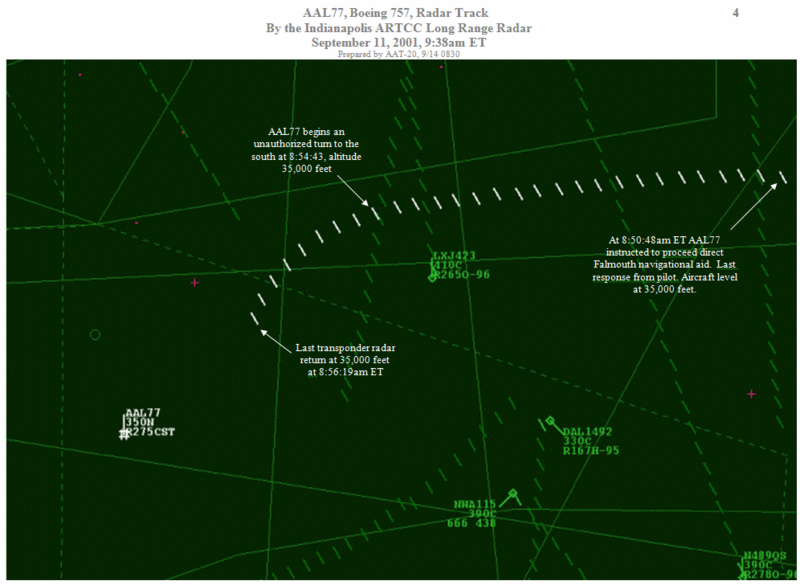
The following FAA memorandum explains why this happened, and how a flight path was eventually reconstructed:
The loss of radar contact isn't some invention of the 9/11 Commission, then. It's confirmed by an FAA document dating from within a week of the attacks.
Challenges
Information to corroborate the 9/11 Commission Report is freely available, then, but nonetheless there are many who say this cannot be an accurate explanation of what happened.
For example, Nafeez Ahmed wrote in his book The War On Truth that the "unfathomable failure of FAA radar" was "an incoherent narrative that is clearly therefore untrue", concluding that "the Commission's account is unsubstantiated and contradictory - clearly the FAA and NORAD were aware that Flight 77 was heading towards Washington, DC". And David Ray Griffin wrote in Debunking 9/11 Debunking that aspects of the story "strain credulity" and "we have very strong reasons to consider the tapes-based of AA 77 false". Both books muster several arguments to support their views, and we'll consider them here.
Hijacking knowledge
The 9/11 Commission Report told us that the Indianapolis controller handling Flight 77 was unaware of the other hijackings, and so initially suspected the aircraft was suffering mechanical or electrical problems. David Ray Griffin questions whether this was really possible, though.
...contrary to the claim that the Indianapolis Center did not know of previous hijackings, Boston flight controllers, according to stories in the Guardian and the Village Voice that appeared shortly after 9/11, had at 8:25 notified other regional centers - one of which was Indianapolis - of the hijacking of Flight 11. That this notification was common knowledge was confirmed by the aforementioned NBC program narrated by Tom Brokaw, which said that at 8:30AM, "Boston Center supervisors notify the FAA and other air traffic centers about the hijacking of American Airlines Flight 11."
Debunking 9/11 Debunking - David Ray Griffin
Dr Griffin doesn't provide links for the Guardian and Village Voice stories, however we believe he sourced his information from the Flight 11 Timeline:
This page contained a link to the Guardian story, but it turns out this contains only one line relevant to Griffin's claim, tucked away in a Flight 11 timeline:
No source, nothing to say that Indianapolis were notified.
What about the Village Voice story? That contains questions about knowledge of hijackings, like this:
There's nothing to support the claim that Indianapolis would have known, though, and little in the way of definitive, sourced information at all. Hardly surprising as the piece is dated September 13th 2001, and was presumably written the day before - there would have been very little to go on.
What about the NBC programme? That was "America Remembers", a piece created for the first anniversary of 9/11. Here's the relevant part of the transcript:
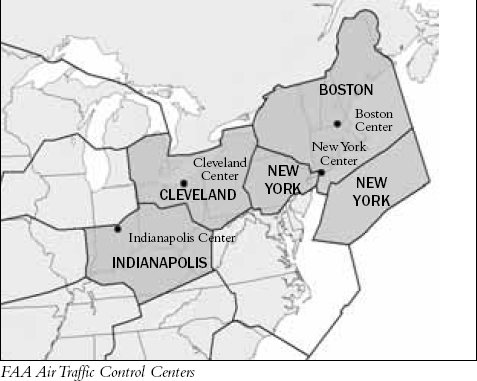
Again, nothing about Indianapolis being informed. Could there be a reason why other areas might be told of the hijackings, but not them? Yes, as it happens, and this information has been available in the Staff Monograph on the Four Flights and Civil Aviation Security all along:
This could have Boston "notifying other regional centers" of the hijacking soon after 8:30, close enough to Dr Griffin's 8:25-8:30 timeline to make it plausible that we're talking about the same event. There's no evidence Indianapolis was one of those centres, though, not in any of Dr Griffin's sources, and we have a plausible reason why that's so: Boston only notified adjoining regions, and Indianapolis wasn't one of them.
Dr Griffin offers no direct evidence to contradict the 9/11 Commission account, then. The best he can do is suggest that they should have known:
With regard to the last point, Dr Griffin appears to suggest the Commission somehow invented the idea that the controller assumed the plane had crashed. This is of course false, as we can see from the FAA Chronology. They were saying this had happened only days after 9/11. Why would the controller have made this assumption if he knew of hijackings?
Dr Griffin is also relying heavily on assumptions here, not only that all this information was sent out as he described, but that every single controller somehow then knew all about it. And that's not necessarily the case, as this January 2004 article opinion piece points out:
It was just after 9 a.m. If the FAA's version of the story is correct, air traffic controllers should have known at 8:20 a.m. that at least one hijacking had taken place - and that the hijacked jetliner had then struck the Trade Center's North Tower at 8:46 a.m.
But last week's transcripts reveal that air traffic controllers at La Guardia were still in the dark even after the North Tower was hit. In one exchange, with the North Tower in flames and just before a second hijacked jetliner struck the Trade Center's South Tower at 9:03 a.m., an unidentified man at La Guardia's control tower asks: "Do you guys know what happened at the World Trade Center?"
A second unidentified man at the control tower answers: "We are listening to it on the news right now. Do you know anything further? What happened, a plane hit it?"
"We heard a bomb hit it," the first man says.
"We heard that a plane hit it," the second man answers, adding that he is just turning on the TV news. "We are trying to get an update."
"But you don't know anything," the first man says.
"We don't know," the second man says. "We're looking at it on Channel 5 right now."
If that conversation was between two ordinary people, it wouldn't be all that disturbing. Indeed, it probably echoes many conversations that day between ordinary citizens trying to find out what was taking place in lower Manhattan. But that conversation was between two people who should have been on top of the information - people in an airport traffic control tower. Why were they in the dark?
The transcripts reveal that even at La Guardia air traffic controllers were still allowing jetliners to take off after the first plane struck. Only after the second plane hit did the FAA order all commercial jetliners grounded across America.
Such a delay raises yet another question: Did the FAA dismiss that first hijacking report at 8:20 a.m.? How else to explain the delay in notifying the military, the delay in notifying air traffic controllers at La Guardia, and even the delay in grounding commercial jets in the New York area and beyond?
Put another way: Just what was the FAA doing?
NorthJersey.comHere we have air traffic controllers only miles from the scene who appear unaware that the World Trade Centre has been hit by a hijacked plane, more than 15 minutes after it happened. There's no indication of reports flying around the ATC world here.
We asked Colin Scoggins about this, the military liasion at Boston who has many years of air traffic control experience.
911myths: The 9/11 Commission Report tells us that Indianapolis didn't know anything of the other hijackings at 8:54, and so assumed the missing Flight 77 had crashed. However it's argued that this cannot be true, that the entire air traffic control community would have known about the hijacking of flight 11 within a few minutes of first being notified, perhaps 8:30 or so.
Scoggins: People in the cafeteria may have had the info first, probably from seeing it on CNN, if they had the channel up. I doubt at 8:54 they knew, My guess is they would have known about some time later like maybe 5 or 10 minutes. The OMIC probably would have known next, I assume someone would have let him know. I'm not sure when he recieved a report of the hijacks. My guess as soon as they did, they were probably questioning themselves almost immediatelly wondering if their potential crash was instead a hijack. I can imagine it was pretty emotional for them if they thought their plane had crashed.
911myths: But is there some mechanism where an individal might hear what had happened?
Scoggins: We don't have news source whatsoever in the operational room, and the news is so much real time. During the war in Kosovo, we had just received notice on a classified document that had just been declassified regarding some stealths (F-117) going overseas, CNN already had them airborne prior to us getting the unclassified message. We wouldn't know any earlier unless it was happening in the sector you were working. My guess we had controllers in our Center that didn't know anything for up 30 minutes if not more.
911myths: You say "My guess we had controllers in our Center that didn't know anything for up 30 minutes if not more." Do you mean “up to 30 minutes after the first notification” – so, someone knows of the hijackings at Boston at 8:20-something, it takes 30 minutes or more for everyone at Boston to hear about it, and then other sectors might hear the news some time after that?
Scoggins: Easily, we have five Areas, there would no reason for someone in Area D to know about AAL11, it never hits their airspace, the only way they would know is if someone told them when they were on break, or they overheard them talking about it on break. On a day shift each area has about 15 controllers on in the morning. Each Area has their busy time periods. It was a gorgeous day, there were probably 15 to 20 controllers on break and of that 5 to 8 were probably outside of the building taking walks, its not uncommon to see that many walking around for exercise during their 20 to 30 minute breaks.
An air traffic controller who was there on the day finds nothing surprising about the idea that the Indianapolis controller was unaware of the other hijackings, then.
Oddly, in Dr Griffin's Debunking 9/11 Debunking he would debunk his own claim by quoting Pamela Freni's "Ground Stop", which said: "At 9:07 AM a message was sent from the Air Traffic Control System Command Center in northern Virginia to every air traffic facility in the nation, announcing the first hijacking." The Indianapolis Centre manager didn't make any concerns about flight 77 known until 9:20, so there may be an argument that he was slow to respond, but that's not necessarily true. It could take time for the contents of this message to reach the manager, for instance (especially if he's busy on the phone or engaged with his staff regarding the suspected crash). And even on hearing the report, he may not initially link this to Flight 77. What seems clear to us now wasn't quite so obvious back then. For example, Pamela Freni reported in Ground Stop that FAA headquarters, on hearing of the hijacking, and then the plane hitting the World Trade Centre, didn't immediately think the two incidents were linked (Ground Stop, page 63. It took time for the reality to hit home.
That's all speculation, of course, but in any event, even Dr Griffin's own quote places no formal notification of the hijackings until more than 10 minutes after Flight 77 had disappeared from radar. He has failed to provide any substantive evidence to contradict the FAA chronology or 9/11 Commission account, showing that Indianapolis considered the plane had crashed before later thinking it may have been hijacked.
Widespread hijacking knowledge
Dr Griffin points to others who he says knew of the hijacking of Flight 77:
The FBI
The Commission's tape-based story is also challenged by the existence of many published reports indicating that officials knew about flight 77's hijacking some time before the Pentagon was struck. In the FBI section of the Arlington County "After-Action Report" on the Pentagon attack, for instance, we read: "At about 9:20 AM, the [FBIs] WFO [Washington Field Office] Command Center was notified that American Airlines Flight #77 had been hijacked shortly after takeoff from Washington Dulles International Airport." The 9/11 Commission simply treated all such reports as if they had never been written.
Debunking 9/11 Debunking - David Ray Griffin
Dr Griffin does his best to make this information seem significant, by pretending that the 9/11 Commission somehow suppressed it. The reality is a little different. Take a look at the Commission Staff Report covering the chronology of the planes and you'll see the following entry for flight 77:
Ted Olson could have completed a phone call with his wife by around 9:17 AM. He knew the flight number. We have a specific report that he's called the Department of Justice, who would presumably have reported this immediately to the FBI. It's also conceivable that someone else could have called them - someone in Olson's or the Attorney General's office, say. If Olson "called collect", then maybe she also asked the operator to do it. The times are a little tight - if the information came from Olson then we must assume his wife called earlier, rather than later - but the 9/11 Commission has provided a mechanism here that might explain how the FBI would know about the hijacking before NORAD.
What is the significance of this information, though? Dr Griffin doesn't explain. Presumably he's attempting to imply that if the FBI knew at 9:20 or so, then it's inconceivable that NORAD wouldn't receive the same information for another ten minutes or more. But if that is what he's saying, then we disagree. The FBI surely aren't going to take it on themselves to inform NORAD (how can they, with no positional information, tail number or anything else?) Instead the information will be forwarded to someone who can deal with the case. They will then contact the FAA to try and verify the hijack story, see what's known about the situation already. This all takes time, and it's not in the slightest bit surprising that FBI knowledge of the hijacking wouldn't reach the military in just a few minutes.
The Secret Service
Next, Dr Griffin tells us that the Secret Service also had useful knowledge regarding Flight 77:
The Secret Service did indeed receive real-time information about the approaching Flight 77. The 9/11 Commission told us about it here:
The plane was being tracked in its final minutes. There's nothing in Riggs' statement to contradict that, and in fact if you read the part of the paragraph Dr Griffin left out then this becomes obvious:
There's confirmation by Richard Clarke that this information only arrived very late. Here's what immediately followed Dr Griffin's quote:
Stafford slipped me a note. "Radar shows aircraft headed this way." Secret Service had a system that allowed them to see what the FAA's radar was seeing. "I'm going to empty out the complex." He was ordering the evacuation of the White House.
Ralph Siegler stuck his head into the room. "There has been an explosion in the Pentagon parking lot, maybe a car bomb!"
Richard Clarke, Against All Enemies
Clarke links the warning to the evacuation of the White House, but this didn't occur until after the Pentagon was hit.
As for the Secret Service knowing everything the FAA knew, let's keep in mind that the FAA didn't know for sure that Flight 77 was hijacked, and they had no idea it was "heading back towards Washington". The flight was simply "missing". Dr Griffin appears to believe that, based on this information, the Secret Service should have informed NORAD directly. But why would the Secret Service have bypassed the FAA and taken this task on for themselves? They wouldn't necessarily know the tail number, transponder code, last position, number of passengers on board, destination or anything else (unless they'd overheard it and happened to note all this down). We're not at all surprised that the Secret Service didn't call NORAD: they had nothing to tell them, and it wasn't their responsibility. The Secret Service would be monitoring the teleconference in order to take action if a concrete threat emerged, not to try and second-guess the FAA.
Military Liaisons
Dr Griffin concludes by explaining that military liaisons also knew about Flight 77. He quotes Ben Sliney:
Available to us at the Command Center of course is the military cell, which was our liaison with the military services. They were present at all of the events that occurred on 9/11... If you tell the military you've told the military. They have their own communication web... [I]n my mind everyone who needed to be notified about the events transpiring was notified, including the military.
Monte Belger, FAA's acting deputy administrator on 9/11:
[I]t is a fact-there were military people on duty at the FAA Command Center, as Mr Sliney said. They were participating in what was going on. There were military people in the FAA's Air Traffic Organisation in a situation room. They were participating in what was going on.
Dr Griffin points to confirmation by Pamela Freni, who in her book Ground Stop referred to "the onsite Department of Defense (DoD) liaison to the FAA", and concludes:
These testimonies to the existence of military liaisons contradict the 9/11 Commission's claim about Flight 77 - that although Flight 77's troubles were known at Herndon and FAA headquarters, they were not known by the military. The 9/11 Commission dealt with this contradiction by ignoring it. Like the FAA memo sent my Laura Brown, the testimonies given by Sliney and Belger about military liaisons were not mentioned in the 9/11 Commission Report.
David Ray Griffin, 9/11 Contradictions
What, exactly, is Dr Griffin's point here? He doesn't appear to be explicitly saying that if these liaisons were present, then information should have filtered from them back to NORAD. And that's just as well, as to prove this we'd have to know who they were, where they were, when they began work, what information they received, and what they did with it. And no answers to those questions have been provided here.
Dr Griffin also omits some interesting parts of Ben Sliney's testimony, where he reveals that there were no FAA procedures in place for the Command Center to request fighter assistance from NORAD:
MR. GORTON: On 9/11, the Command Center effectively was the nerve center for information on suspicious aircraft. Yet as I understand it the Command Center had no defined role with respect to obtaining military assistance, fighter assistance. Is that correct? And, if so, why weren't those authorities combined?
MR. SLINEY: Available to us at the Command Center of course is the military cell, which was our liaison with the military
services. They were present at all of the events that occurred on 9/11.
The normal protocols for the events that were transpiring then -- that is to say hijacked aircraft, which requires a
notification to NORAD -- those, at least I was given to understand, were made promptly -- the notifications on each
hijack. The --
MR. GORTON: You understood that they were made promptly?
MR. SLINEY: That's correct.
MR. GORTON: It wasn't you -- it wasn't your responsibility to do so?
MR. SLINEY: That is correct. I believe I am correct in stating that that responsibility devolves upon the air route
traffic control center in whose jurisdiction that hijack occurs. I was given to understand that all such notifications were made. I had no reason to believe they were not.
The -- I'm getting away from your question, though. You ask me if we had a procedure in place to deal with such an event --
is that what you're asking?
MR. GORTON: At the Command Center.
MR. SLINEY: With -- well, I just want to be clear on this aspect of it. Dealing with aircraft that would be hijacked and
used as weapons?
MR. GORTON: No.
MR. SLINEY: No. Dealing with hijacked --
MR. GORTON: Dealing with direct notification to the military or request for assistance from the military.
MR. SLINEY: In direct response to your question was FAA headquarters primarily through the security organization to
request assistance from the military. We had no process in place where a Command Center would make such a request for a military assistance. I believe the military was involved, and you know I suppose in hindsight it's too simplistic to say that they all look alike to me. If you tell the military you've told the military. They have their own communication web that I think defeated some of the notification processes, as I've been listening to today. But in my mind everyone who needed to be notified about the events transpiring was notified, including the military.
MR. GORTON: By the Command Center?
MR. SLINEY: Correct.
http://govinfo.library.unt.edu/911/archive/hearing12/9-11Commission_Hearing_2004-06-17.pdf
If Sliney made the assumption that NORAD had already been informed, and everyone believed that the NMCC was monitoring the hijack conference call from 9:20, and there were no procedures for the FAA Command Centre to ask for military assistance anyway, then we see no reason to believe that FAA-based military liaisons would have contacted NORAD directly.
Of course it's also possible that Dr Griffin is simply playing a semantic game: the 9/11 Commission in a section titled "military awareness" say NORAD didn't know about Flight 77 until after 9:30, and so Dr Griffin is pointing to the fact that some individual military employees may have known about the missing flight (and concerns that it may have been hijacked) before then. Very good. He's not proved that, though, or shown if true that it has any significance or would have changed anything, or even speculated on what its significance might be. This is perhaps the most substance-free argument so far.
See also Military liaisons.
NORAD not informed
Ahmed starts by claiming that FAA delays in requesting a NORAD intercept and informing its own headquarters were "inexplicable":
...At 8:54 AM, the Commission reports, the flight [77] deviated from its flight path with a "slight turn towards the south." The Commission cites the controller saying he saw the aircraft "turning to the southwest, and then saw the data disappear" from the radar at 8:56 AM. According to this narrative, the controller had no inkling that Flight 77 had been hijacked. However, the Commission concedes that despite the fact that all radio contact had been lost, and the plane had not only deviated from its flight path but disappeared completely, no fighters were scrambled to intercept the plane in accordance with standard procedures. The controller, rather, "believed American 77 had experienced serious electrical and/or mechanical failure, and was gone." Despite the fact that the FAA notified its other internal agencies of the problem, the Commission claims that NORAD was not informed in the same manner. Instead, controllers apparently waited until 9:09 AM - 13 to 15 minutes - before informing the FAA regional center, which in turn waited another 15 minutes before informing FAA headquarters at 9:24 AM. Both these delays in themselves are inexplicable.
Chapter 10, The War On Truth, Nafeez Ahmed
Ahmed assumes information should normally be passed on far more quickly than happened here, but that's not borne out elsewhere.
In the famous Payne Stewart case, for instance, controllers found Stewart's jet offered no response to a radio request at 9:33:38. The controller continued trying to contact the plane for a further four and a half minutes. Even though in this case NORAD had a clear part to play, as the plane was still visible on primary radar, they still weren't notified until 9:55, some 21 minutes after the problem had been noticed, perhaps 17 minutes after it was confirmed.
Ahmed's description of controllers as "waiting" before informing the FAA might also lead you to believe they were inactive for a long time, but that simply wasn't true, and indeed the Commission told us that Indianapolis didn't begin acting on their suspicions that the plane had crashed until "shortly after 9:00". So it's reasonable to assume that, just as in the Payne Stewart case, he spent four or five minutes trying to regain contact with the plane.
The controller would then need to escalate the situation to his supervisor, and explain the problem. The Commission describe them continuing to look for the plane.
The report then told us that "At 9:08, Indianapolis Center asked Air Force Search and Rescue at Langley Air Force Base to look for a downed aircraft", as well as contacting the West Virginia State Police and asking for reports of a downed aircraft, passing this information on to the FAA regional centre a minute later. All this has happened within 13 minutes of the problem being identified, perhaps 9 minutes of it being confirmed: not such a bad record. (It did take 15 minutes for the regional centre to pass this on to FAA HQ, but we'd need something more than Ahmed's rhetoric to justify describing that as "inexplicable".)
NORAD weren't contacted, that's true, but as we've seen (and Ahmed forgot to point out) Indianapolis Centre did get in touch with the military, they just happened to choose more appropriate people to help out with the crash they believed might have occurred. What more would NORAD do in a potential rescue situation, without even having a position for the plane?
Colin Scoggins, military liaison at Boston on 9/11 and an experienced air traffic controller confirmed that calling NORAD is not always the first action he would take in an emergency:
Bowman comment: Dr. Robert Bowman, retired USAF pilot, notes that anytime an aircraft goes off course, or loses radio communication, or loses it's transponder signal, anytime any ONE of those things happen, the aircraft is supposed to be intercepted.
Scoggins: Then there wouldn't be enough planes to intercept them all. We have planes go NORDO all of the time, normally we get them back in several minutes, but at what time is the controller supposed to call for the intercept. Inflight emergenices don't last very long, if it is a seroius emergency then they are landing at the closest field possible. Why would I call up a scramble to intercept someone who just lost an engine or a fire on board, when the quickest thing we are trying to do is get them down. Makes no sense at all. Most of the emergencies I have worked were over in 10 to 15 minutes.
We see no reason to be surprised that NORAD weren't contacted, then. There's no reason to believe that Indianapolis were aware of the other hijackings, and getting in touch with Air Force Search and Rescue made more sense if you wanted to locate a downed aircraft.
Tracked or not tracked
Ahmed points to what he seems to believe is a contradiction in the 9/11 Commission's account.
On the one hand, the Commission says that there was poor primary radar in that area -- but if the regional radar was poor and therefore unable to track the flight, then the Commission's initial admission that the FAA radar had indeed tracked the flight loses value. The Commission also blames problems due to the software's processing of the information - but if such problems are indeed inherent to the functioning of the software itself and its processing of radar data, then it would follow that the software itself is fundamentally flawed. In that case, the ensuing problem of primary radar not being displayed to controllers would be endemic, such that this problem would continually arise as long as the software is being used.
Chapter 10, The War On Truth, Nafeez Ahmed
His first issue is addressed in a 9/11 Commission Report footnote that we reproduced above:
142. Primary radar contact for Flight 77 was lost because the “preferred” radar in this geographic area had no primary radar system, the “supplemental” radar had poor primary coverage, and the FAA ATC software did not allow the display of primary radar data from the “tertiary” and “quadrary” radars.
The Commission were not saying that all the FAA radar systems were unable to fully track Flight 77, just the preferred and supplemental radars. Flight 77 could still have been tracked on the “tertiary” and “quadrary” radars, and so accessible for later analysis by the Commission, but these wouldn't have been visible to air traffic controllers at the time.
This isn't some invention of the Commission, either. We've also seen broad confirmation of the report from an early FAA document.
Ahmed's second issue is correct, this would have been endemic at the time: and this means what, exactly? It's a fact that there are areas in the US that don't have radar coverage, as Ralph Yost of the FAA describes:
Radar isn't perfect, then, but for aircraft with their transponders on, and maintaining an expected course, this need not be a significant issue. Of course on 9/11 both these conditions changed.
If this is truly an issue, then we'd suggest Ahmed or some other 9/11 researcher get in touch with air traffic controllers who can explain why the system didn't work the way the 9/11 Commission describe. There must be thousands of people who would know about this, and testimony from a few of them would be valuable. Otherwise all we have here is Ahmed's personal incredulity, and that's evidence of precisely nothing at all.
Phantom Flight 11
Ahmed says another contradiction shows the FAA were tracking Flight 77 as it moved towards Washington.
...at 9:21 AM the FAA informed NORAD - according to the Commission - that a "hijacked" Flight 11 (not Flight 77) was "heading into Washington," prompting NORAD to send scramble orders at 9:24 AM to Langley Air Force Base. The Commission is "unable to identify the source of this mistaken FAA information." Langley fighters were then reportedly airborne at 9:30 AM. Moreover, NORAD was not informed by the FAA at all about the purportedly lost Flight 77 until 9:34 AM - 4 minutes before it crashed into the Pentagon.
This entire narrative is not only internally incoherent, but in contradiction to other authoritative accounts. For instance, the FAA clearly knew that a third plane was hurtling towards Washington, DC. But if controllers were not able to find Flight 77 on their primary radar such that the flight was effectively "lost," what radar data was being monitored by the FAA proving that a phantom "Flight 11" was speeding towards Washington, DC? Clearly, the FAA must have been monitoring the hijacked flight headed towards Washington, DC - Flight 77. Furthermore, given that the FAA was well aware that Flight 11 had already crashed into the north tower of the World Trade Center, how could it have been presumed to have been the same flight now heading toward Washington, DC?
Chapter 10, The War On Truth, Nafeez Ahmed
Ahmed claims the "phantom flight 11" was tracked on radar, that this was actually Flight 77, and the FAA must have realised this at the time as they already knew Flight 11 had crashed. It sounds convincing, until you spot the flawed assumption: there's no evidence whatsoever that the "phantom flight 11" ever appeared on radar.
Here's the original call reporting that flight 11 is still in the area, for instance:
<mp3>NoradScogginsFlight11a.mp3|download</mp3>- NORAD - Flight 11 still in the air, 9:21
Scoggins doesn't have a position on the plane.
As the 9/11 Commission Report reported, the Mission Crew Commander had the same problem:
Mission Crew Commander, NEADS: Okay, uh, American Airlines is still airborne. Eleven, the first guy, he’s heading towards Washington. Okay? I think we need to scramble Langley right now.And I’m gonna take the fighters from Otis, try to chase this guy down if I can find him.
"If I can find him" - they didn't have a position.
There's further confirmation in the Vanity Fair article, "The NORAD Tapes", that broke a lot of new information on NORAD's 9/11 response:
09:21:50
NASYPANY: O.K. American Airlines is still airborne—11, the first guy. He's heading towards Washington. O.K., I think we need to scramble Langley right now. And I'm—I'm gonna take the fighters from Otis and try to chase this guy down if I can find him.
Arnold and Marr approve scrambling the two planes at Langley, along with a third unarmed trainer, and Nasypany sets the launch in motion.
It's a mistake, of course. American 11 was, indeed, the plane that hit the first tower. The confusion will persist for hours, however. In Boston, it is Colin Scoggins who has made the mistaken call.
"When we phoned United [after the second tower was hit], they confirmed that United 175 was down, and I think they confirmed that within two or three minutes," Scoggins, the go-to guy at Boston Center for all things military, later told me. "With American Airlines, we could never confirm if it was down or not, so that left doubt in our minds."
An unwieldy conference call between F.A.A. centers had been established, and Scoggins was monitoring it when the word came across—from whom or where isn't clear—that American 11 was thought to be headed for Washington. Scoggins told me he thinks that the problem started with someone overheard trying to confirm from American whether American 11 was down—that somewhere in the flurry of information zipping back and forth during the conference call this transmogrified into the idea that a different plane had hit the tower, and that American 11 was still hijacked and still in the air. The plane's course, had it continued south past New York in the direction it was flying before it dipped below radar coverage, would have had it headed on a straight course toward D.C. This was all controllers were going on; they were never tracking an actual plane on the radar after losing American 11 near Manhattan, but if it had been flying low enough, the plane could have gone undetected. "After talking to a supervisor, I made the call and said [American 11] is still in the air, and it's probably somewhere over New Jersey or Delaware heading for Washington, D.C.," Scoggins told me.
http://www.vanityfair.com/politics/features/2006/08/norad200608?currentPage=6"They were never tracking an actual plane on the radar after losing American 11 near Manhattan, but if it had been flying low enough, the plane could have gone undetected".
This all seems clear enough, but these are important details and so we located Colin Scoggins, the man who made the call about the "phantom Flight 11" and asked him about it.
911myths: Why did you believe that Flight 11 may still be in the air?
Colin Scoggins: I was listening on a Telcon with some people at Washington HQ, and other facilities as well, but don't know who they were. Didn't know the people at FAA HQ either. It was some kind of security telcon. I was in contact with many people at that time, UAL175 had crashed. NEADS was interested in Tail Numbers of AAL11 and UAL175. I believe it was either Dan Bueno the Supervisor in charge, or Bo Dean who made some initial calls to the airlines requesting if their aircraft were down, and tail number information. UAL Airlines replied within minutes that they could confirm UAL 175 was down, and they had the tail number. AAL Airlines was totally different. They do what I think they are supposed to do, by locking down their computer after an aircraft crashes, but when they did that, they couldn't access passenger lists, route of flight, it locks everyone out. So we never got confirmation that the plane was down. Somehow this either got misconstrued, and ended up in FAA channels, indicating the plane never crashed, or what I think happened is that someone in HQ knew that AAL77 was missing, and when they were talking about AAL77 they may have dropped the numbers and were reporting that AAL was still missing or still flying but no one knew where. I think this ended up on the telcon as AAL 11 is still airborne. From my point of view the aircraft was heading south at low altitude and we had lost radar, my only guess was he was heading for Washington DC. I found out years later and I am 99% certain the person who made that call on the telcon was Dave Canoles, he has since retired. I took the information I received and called NEADS almost instantly, can't tell you who I told that to, I talked with so many people there the whole day.
911myths: Several 9/11 researchers authors have reported that the “phantom flight 11” was spotted on radar. Is that true?
Colin Scoggins: I have no idea where that came from. Once we lost the aircraft we never even had a hint of another target. I even called FACSFAC VACAPES which has radar up and down the coast, to look for targets, they didn't come up with any.
911myths: If it was never on radar, why say it was going to Washington?
Colin Scoggins: Again it was just my hunch, as where they were heading. The aircraft would have enough gas to get there even at low altitude, but if the aircraft was heading to Cuba, it would never make it at low altitude. Couldn't think of any other important targets on the east coast, so that was where my mind was. I also tried to guess where the aircraft would be at the speed it was traveling.
Scoggins tells us that the "phantom Flight 11" was not tracked by radar, then. It was not the same as the missing Flight 77, and it does not show that the FAA were monitoring the approach of Flight 77.
Scoggins also explains that the FAA did not know for sure that Flight 11 was the first plane to hit the World Trade Centre as American Airlines hadn't yet confirmed this. There was no contradiction in a report that it was still in the air, and so neither of Ahmed's points stand up to scrutiny.
Col Alan Scott
Ahmed's final significant argument comes in the testimony of Col Alan Scott.
In fact, according to testimony under oath before the Commission under NORAD official on duty on 9/11, Col. Alan Scott: "At 9:24, the FAA reports a possible hijack of 77. That's some time after they had been tracking its primary target. And at that moment as well is when the Langley F-16s were scrambled out of Langley." A minute later, according to Col. Scott, "American 77 is reported heading towards Washington, D.C."
Chapter 10, The War On Truth, Nafeez Ahmed
It's no secret that this testimony contained many errors, though. Some issues are apparent to even the most casual observer (our emphasis):
Here Scott says that Flight 77 reappeared on radar screens at 9:09, much earlier than the Commission claimed, when it would have been over West Virginia. But he then explains they tried to figure out who is was by asking a "C-130 that is westbound toward Ohio", and if Scott is referring to Steve O'Brien's plane then that wouldn't happen for almost another 25 minutes. Are we really to believe that air traffic controllers asked "a lot of people" but couldn't get anyone to identify the plane for all that time? Or was the plane really not spotted until after 9:30, just as the Commission said, and the C-130 was asked to check out the plane just as soon as it appeared?
The particular case of NORAD being informed about the Flight 77 hijack at 9:24 was addressed in a 9/11 Commission hearing:
That is, the 9:24 entry reflected the call NORAD received telling them Flight 11 was still in the air. The Commission Report provided more details here:
In public testimony before this Commission in May 2003, NORAD officials stated that at 9:16, NEADS received hijack notification of United 93 from the FAA. This statement was incorrect. There was no hijack to report at 9:16. United 93 was proceeding normally at that time.
In this same public testimony, NORAD officials stated that at 9:24, NEADS received notification of the hijacking of American 77. This statement was also incorrect. The notice NEADS received at 9:24 was that American 11 had not hit the World Trade Center and was heading for Washington, D.C.
In their testimony and in other public accounts, NORAD officials also stated that the Langley fighters were scrambled to respond to the notifications about American 77, United 93, or both. These statements were incorrect as well. The fighters were scrambled because of the report that American 11 was heading south, as is clear not just from taped conversations at NEADS but also from taped conversations at FAA centers; contemporaneous logs compiled at NEADS, Continental Region headquarters, and NORAD; and other records.
Yet this response to a phantom aircraft was not recounted in a single public timeline or statement issued by the FAA or Department of Defense. The inaccurate accounts created the impression that the Langley scramble was a logical response to an actual hijacked aircraft.
In fact, not only was the scramble prompted by the mistaken information about American 11, but NEADS never received notice that American 77 was hijacked. It was notified at 9:34 that American 77 was lost.Then, minutes later, NEADS was told that an unknown plane was 6 miles southwest of the White House. Only then did the already scrambled airplanes start moving directly toward Washington,D.C.
Thus the military did not have 14 minutes to respond to American 77, as testimony to the Commission in May 2003 suggested. It had at most one or two minutes to react to the unidentified plane approaching Washington, and the fighters were in the wrong place to be able to help.They had been responding to a report about an aircraft that did not exist.
Nor did the military have 47 minutes to respond to United 93, as would be implied by the account that it received notice of the flight’s hijacking at 9:16. By the time the military learned about the flight, it had crashed.
Chapter 1, 9/11 Commission Report
The problems with FAA and NORAD testimony were criticised further in Kean and Hamilton's book, Without Precedent.
The other issue to resolve in advance of the hearing was how to handle the discrepancies in the earlier FAA and NORAD testimony before the commission. Our staff was exceedingly frustrated by their problems with the FAA and NORAD. Fog of war could explain why some people were confused on the day of 9/11, but it could not explain why all of the after-action reports accident investigations and public testimony by FAA and NORAD officials advanced an account of 9/11 that was untrue.
There was discussion within our staff about whether or not to investigate how the inaccurate story became the official account presented by NORAD and the FAA. The issue was presented to the commission in May 2004, in an extended memo and presentation. At that point, we did not have time to launch a separate investigation into why the FAA and NORAD had presented inaccurate information in public, nor was that issue clearly under the commission's mandate. We decided to refer the matter to the inspectors general at the Departments of Transportation and Defense. The results of those two investigations are still pending as of this writing.
Without Precedent, Thomas Kean and Lee Hamilton
Those investigations later reported that there was no intent to mislead, although two officials were culpable for allowing errors to remain on the record:
Investigators found no evidence that aviation officials intentionally misled the Sept. 11 commission when they made inaccurate statements about their response to the 2001 terrorist attacks but recommended that two officials face "appropriate administrative action" for failing to correct the record, according to a report released yesterday.
The findings by the Transportation Department's acting inspector general, Todd J. Zinser, address a lingering question about the response on Sept. 11 by military and civilian aviation officials, who initially portrayed the reaction as swift and efficient. It was later shown to be neither.
The conclusions echo the findings of a separate inquiry at the Defense Department, which found no evidence that authorities at the North American Aerospace Defense Command (NORAD) intended to mislead the Sept. 11 panel.
For more than two years after the attacks, officials at NORAD and the Federal Aviation Administration suggested in public statements and testimony that air defenses and aviation officials had reacted quickly to the hijackings and were prepared to shoot down United Airlines Flight 93 if it threatened Washington. That aircraft crashed in Pennsylvania after passengers attempted to retake control from the hijackers.
In fact, the Sept. 11 commission found, audiotapes and other evidence showed clearly that the military never had any of the hijacked airliners in its sights and chased a phantom aircraft -- American Airlines Flight 11 -- long after it had crashed into the World Trade Center.
The FAA had said on its Web site and in statements to the commission that it informed the Pentagon at 9:24 a.m. that American Airlines Flight 77 had been hijacked. The commission found that the FAA never notified defense officials of the hijackings but did label the plane missing after it had crashed into the Pentagon.
The FAA also omitted from official timelines the fact that it notified NORAD about the hijacking of Flight 93 at 10:07 a.m., after the airliner had crashed in Pennsylvania. It gave an earlier than actual time for the moment when an Air Force official joined an FAA "phone-bridge" focused on the hijackings.
Zinser's report blames the erroneous statements on a series of innocent mistakes, including an erroneous entry in an early FAA timeline and an assumption by some officials that others would correct the record once the errors became clear.
"We did not find evidence to conclude that FAA officials knowingly made false statements," the report said.
At the same time, it said, two unidentified FAA officials should have notified the commission when it became clear that the information was wrong. The report recommended that the FAA consider unspecified administrative action against them.
Although the inaccurate statements have been publicly known for several years, it has only become clear more recently how much the issue had strained relations between the Sept. 11 panel and the FAA and NORAD. They were the only two agencies to receive subpoenas from the commission.
Some commission members and staffers were so angered by the inaccuracies that they advocated referring the matter to the Justice Department for criminal investigation. The panel settled on a compromise, referring the complaints to the two inspectors general.
In their new book, "Without Precedent," the commission's chairman and vice chairman, Thomas H. Kean (R) and Lee H. Hamilton (D), said the panel was "exceedingly frustrated" by the FAA and NORAD.
"Fog of war could explain why some people were confused on the day of 9/11, but it could not explain why all the after-action reports, accident investigation, and public testimony by FAA and NORAD officials advanced an account of 9/11 that was untrue," they wrote.
The FAA said in a statement that Zinser's report "clarified the record and found no evidence that FAA officials knowingly made false statements or intentionally failed to correct any inaccurate statements while providing more than 6,000 documents and materials to the commission." The FAA also has "made major improvements to its communications capabilities" since the Sept. 11 attacks, the statement said.
http://www.washingtonpost.com/wp-dyn/content/article/2006/09/01/AR2006090101498.html
It's possible to argue that this is all a coverup, of course, however just saying that doesn't make it so. We need to look at the other arguments regarding the Commission's account of Flight 77 to discover whether there's any supporting evidence for Scott's timeline.
Media Reports
"A number of reports based on FAA and NORAD sources provide a different picture to that being constructed by the Commission", Ahmed explains. But what will this prove?
If you search every report of an incident, especially one as widely covered as 9/11, then of course you'll find differences. For example, the Flight 93 crash time has varied considerably in media reports:
| Time
|
Reported by
|
On
|
| 9:58
|
Pittsburgh Post-Gazette
|
16th September 2001 (Source)
|
| 10:00
|
Canadian News Presswire
|
11th September 2001 (Lexis Nexis)
|
| 10:01
|
Gannett News Service
|
11th September 2001 (Lexis Nexis)
|
| 10:03
|
Los Angeles Times
|
11th September 2001 (Source)]
|
| 10:03
|
CNN
|
11th September 2002 (Source)]
|
| 10:06
|
CNN
|
11th September 2002 (Source)
|
| 10:10
|
CNN
|
12th September 2001 (Source)
|
| 10:20
|
WTAE.TV
|
11th September/ October 2001 (Source)
|
| 10:37
|
Toronto Sun
|
12th September 2001 (Lexis Nexis)
|
| 10:40
|
Seattle Times/ Daily News, New York
|
13th September 2001 (Lexis Nexis)
|
| 10:40
|
The Herald-Sun (Durham, NC)
|
12th September 2001 (Lexis Nexis)
|
| 10:40
|
Abilene Reporter-News
|
12th September 2001 (Source)
|
This isn't actually evidence of anything, though, other than the fact that reporters were relying on hints and off-the-record briefings, perhaps from people who didn't have the whole picture.
But let's suppose they got a briefing straight from a high-up NORAD and FAA official. Again, so what? It's already been alleged that their timetables were incorrect. Reproducing media reports sourced from NORAD is another way to duplicate the Col. Alan Scott timeline, and isn't any kind of independent verification.
Anyway, Ahmed offers the following examples.
As early as 8:46 AM - exactly the same as the first WTC crash - Flight 77 deviated severely off course, heading first due north, then turning due south again before returning to its assigned course. USA Today flight path maps show that it went off course for approximately 15 miles for five minutes.
Chapter 10, The War On Truth, Nafeez Ahmed
Ahmed references the Cooperative Research web site for this claim. However, as we write its current Flight 77 timeline contains nothing to support the story.
Next we get this:
According to The New York Times, "within a few minutes" after 8:48 am when the first news reports of the first WTC attack emerged, controllers knew that "both United 175 (the second plane to hit the World Trade Center) and American 77 (which hit the Pentagon) had probably been hijacked."
Chapter 10, The War On Truth, Nafeez Ahmed
Ahmed has omitted some qualifications in the original story, though.
The article did not say "controllers knew"; it claims "controllers would have known". It's an inference. The author specifically says this isn't an official FAA timetable, so it's an inference made by some unknown contact of his. And we can get a feel for the accuracy involved here in the claim that Flight 77 "stayed aloft until 9:45", when actually it crashed at 9:37:46. This isn't a great surprise: the story appeared on September 15th 2001, presumably being written the day before, so it's relatively early and inaccuracies are to be expected. And as such it can't be relied upon to contradict the 9/11 Commission.
Next up is a Newsday report. Here's part #1:
This isn't the most convincing of arguments. The 9/11 Commission already say that Flight 77 made an unauthorized turn to the south at 8:54. The flight path information shows this was a wide turn, though, and the plane wasn't on its new heading until around 8:59, so there's nothing here to show that "the FAA would have been fully aware that the flight had turned toward Washington, DC, before its transponder was turned off".
Part #2 is supplemented with another report from the Washington Post.
This isn't FAA information, though - their early chronologies don't mention it at all. It's far more likely that the claim of rediscovering Flight 77 came from a NORAD source. Indeed, Col. Alan Scott confirmed it in a Commission hearing:
If this story did come from NORAD then plainly it's not independent confirmation of their timeline, and is rather just repetition of it.
Nevertheless, Ahmed reads big things into these stories.
According to these accounts, based on FAA sources, the Commission's claim - that at 8:56 AM the FAA saw Flight 77 turn towards "the southwest" before its transponder was turned off - is inaccurate. In reality, the FAA had watched Flight 77 on the radar as it turned east towards Washington. Moreover, whether or not it is plausible to believe that the FAA had subsequently lost track of the flight, between 9:05 and 9:10 AM the FAA had undoubtedly recommenced tracking the flight as it headed east towards Washington, DC. The Commission's claim, therefore, that the FAA had lost track of Flight 77 all the way until 9:32 AM, is untrue.
Chapter 10, The War On Truth, Nafeez Ahmed
As we've seen, there's nothing here to say that the controller did not see Flight 77 turn to "the southwest". Ahmed appears to be making something of that fact that the Washington Post said it turned east instead, but there's no contradiction here. The plane simply started a 180 degree turn by heading south west, and kept going until it was heading east.
Further, there's nothing here to justify the statement that "between 9:05 and 9:10 AM the FAA had undoubtedly recommenced tracking the flight as it headed east towards Washington". Ahmed is simply choosing to believe this particular unsourced detail because it's convenient for him to do so. And he can believe what he likes, but let's not pretend it's definitive proof of anything.
Finally, as we've seen, the NORAD tapes already show us that NEADS and the Washington ARTCC Operations Manager, at least, did not have a position for Flight 77 even shortly after 9:30. If the flight was being tracked, a point Ahmed has failed to prove, then they knew nothing about it.
The Laura Brown memo
Ahmed says "authoritative testimony" tells us that NORAD was indeed informed of Flight 77 prior to 9:34:
In an official memo to the Commission read out after the testimony of FAA Administrator Jane Garvey, the FAA pointed out firstly that NORAD was specifically informed of the hijacked Flight 77 heading towards Washington at 9:24 AM - 10 minutes earlier than the Commission claims - and specifically that open lines between the FAA and NORAD had kept NORAD fully informed of Flight 77's activities long before 9:24 AM.
The FAA shared real-time information on the phone bridges about the unfolding events, including information about loss of communication with aircraft, loss of transponder signals, unauthorized changes in course, and other actions being taken by all the flights of interest, including Flight 77. Other parties on the phone bridges, in turn, shared information about actions they were taking.
NORAD logs indicate that the FAA made formal notification about American Flight 77 at 9:24 a.m., but information about the flight was conveyed continuously during the phone bridges before the formal notification.
Moreover, the FAA memo also reveals that NORAD was thereby privy to all FAA information at least as early as the first World Trade Center crash, through the phone bridges which were part of the previously mentioned air-threat conference call:
Within minutes after the first aircraft hit the World Trade Center, the FAA immediately established several phone bridges that included FAA field facilities, the FAA Command Center, FAA headquarters, DOD, the Secret Service, and other government agencies. The US Air Force liaison to the FAA immediately joined the FAA headquarters phone bridge and established contact with NORAD on a separate line.
This information implies that like the FAA, NORAD was aware of Flight 77's hijacking and course towards Washington "within minutes" after 8:48 AM - approximately 8:51 AM by investigator Paul Thompson's calculation. Indeed, their awareness of the danger to DC would have been reinforced at 9:10 AM at the latest when Flight 77 was picked up by the FAA in West Virginia. Furthermore, given the internal incoherence of the claim that the FAA's primary radar monitoring Flight 77 when it first flew off course was faulty, the very narrative that the FAA and NORAD had lost track of Flight 77 at all collapses. Nevertheless, no orders to scramble aircraft were issue by NORAD until 9:23 AM. That is a delay of 32 minutes.
Chapter 10, The War On Truth, Nafeez Ahmed
There are multiple problems with Ahmed's argument.
First, Brown tells us (our emphasis) "NORAD logs indicate that the FAA made formal notification about American Flight 77 at 9:24 a.m., but information about the flight was conveyed continuously during the phone bridges before the formal notification." The only definitive time here comes, once again, from NORAD's timeline. It's repeating the testimony of Col. Alan Scott, not confirming it. It could be argued that saying "information about the flight was conveyed continuously during the phone bridges before the formal notification" is the confirmation, but the fact that Brown needs to use NORAD logs at all tells us she doesn't have a complete timeline of events.
Second, and by way of confirmation, Brown later confirmed to Kyle Hence that she did not have access to all the necessary data:
(I've snipped that to the relevant information for this point, but there's more to read, please check out the whole thing.)
Third, as we've seen, Ahmed's timeline is contradicted by NORAD and FAA documentation. NORAD tapes show that NORAD was unaware of Flight 77 until after 9:30, and the Washington ARTCC manager didn't know its position. And the early FAA Chronology gives an approximate time of 9:25 to 9:30 for when controllers spotted the "primary radar target tracking eastbound" that was Flight 77.
Fourth, Ahmed is deriving precise times from a memo that contains none at all. How can anyone take the paragraph beginning "within minutes after the first aircraft hit the World Trade Center, the FAA immediately established several phone bridges..." and claim this means NORAD knew of the hijacking by "approximately 8:51 AM"? The information simply isn't there to support that. (Especially as no-one at the FAA says they knew it was hijacked at that time.)
It's unnecessary, too, as the FAA have provided more precise details.
An early document covered in handwritten notes talks of the "Washington Primary conference bridge" being established at 9:05, and four internal conferences being set up at 9:08.
The more comprehensive 17th September 2001 Executive Summary gives us the following:
The 9/11 Commission said the FAA hijack conference call didn't start until 9:20. They didn't invent this information, though: FAA deputy administrator Monte Belger told them as much at a Commission hearing:
MR. BELGER: Yes.
MS. GORELICK: Our Staff Statement reflects a very long, 39- minute gap in between when the FAA became aware of the United 93 as a hijacking and when the military was notified at 10:07, which was of course after they impact into the Pentagon. And I want to give you all an opportunity to explain why that occurred -- I'm sorry, not impacted the Pentagon --
MR. BELGER: Well --
MS. GORELICK: -- impact into the ground in Pennsylvania.
MR. BELGER: Right. The most frustrating after-the-fact scenario for me to understand is to explain is the communication link on that morning between the FAA operations center and the NMCC. That's still frustrating for me to understand how that -- I know how it's supposed to work, but I have to tell you it's still a little frustrating for me to understand how it actually did work on that day. It is clear I think in the record that at 9:20 the FAA operations center did call the National Military Command Center and add them into the hijacking net. The hijacking net is an open communication net run by the FAA hijack coordinator, who is a senior person from the FAA security organization, for the purpose of getting the affected federal agencies together to hear information at the same time. That's the purpose of the hijack net. There are other nets off of that, which some are classified and some are real technical command type of discussions. But the fundamental primary source of information between the FAA, DOD, FBI, Secret Service, and which every other agencies -- the airlines would probably be on that net -- is the FAA hijack net. That was activated with the NMCC at 9:20. It was my assumption that morning, as it had been for my 30 years of experience with the FAA, that the NMCC was on that net and hearing everything real-time.
MS. GORELICK: Did you do anything to ensure that your assumption, a costly one, was correct?
MR. BELGER: No. I did as I was -- I was real busy that morning. I did not ask specifically is the NMCC on. And I can tell you I've lived through dozens of hijackings in my 30-year FAA career, as a very low entry-level inspector up through to the headquarters, and they were always there. They were always on the net, and were always listening in with everybody else.
MS. GORELICK: At some point, however, in the course of that call you became aware that the military was not involved in any meaningful way. Is that correct? We heard some rather colorful language came from your mouth at that point.
MR. BELGER: I don't doubt that. Yeah, I mean later in the morning, as I had time to not just react to everything and think, I believe I did ask, you know, Are they on? -- and make sure.
MS. GORELICK: And when you found out that they weren't?
MR. BELGER: No, I wasn't very happy.
9/11 Commission Hearings
So even though Belger thought the military were sharing information through the conference call, this wasn't the case, a fact that has been viewed as suspicious in itself. (It's a win/win situation for the truth movement: whether the military received information early, or late, apparently both options are evidence of an "inside job".)
Fifth, the claim that "the US Air Force liaison to the FAA immediately joined the FAA headquarters phone bridge and established contact with NORAD on a separate line" has also been reported as inaccurate by the Office of the Inspector General report into the FAAs timeline inaccuracies.
Ahmed said of the memo:
This information implies that like the FAA, NORAD was aware of Flight 77's hijacking and course towards Washington "within minutes" after 8:48 AM - approximately 8:51 AM by investigator Paul Thompson's calculation. Indeed, their awareness of the danger to DC would have been reinforced at 9:10 AM at the latest when Flight 77 was picked up by the FAA in West Virginia.
However, there's no evidence that the FAA knew of the hijacking at that time. FAA records do not say they picked up Flight 77 at 9:09, and later claims that the FAA notified NORAD of Flight 77 at 9:24 have been shown to be inaccurate. The NORAD tapes complete the picture by revealing that NEADS didn't know of Flight 77 until they were told, after 9:30, just as the 9/11 Commission reported.
Bill Peacock
In "Debunking 9/11 Debunking" Dr Griffin tells us that Laura Brown's view - that the "FAA initiated teleconference" began around 8:50 - was "independently supported by another high FAA official". Interesting. But not so much that Dr Griffin feels the need to explain immediately, as the details are hidden away in the footnotes:
The other high official was Bill Peacock, the FAA directort of air traffic services, who was in New Orleans. Having learned about the attack on the first tower and got to his hotel room, Pamela Freni reports, "He flipped through the channels and found CNN just in time to join the world in viewing the attack on the second tower. He determinedly dialed the phone, trying to connect with his staff. His call was routed to the phone in the conference room next door to his office at headquarters, into the never-ending teleconference. His deputy Jeff Griffith was serving as Liaison to FAA Deputy Monte Belger, trying to gather a tactical notion of the attacks" (Freni, Ground Stop, 22)
David Ray Griffin, Debunking 9/11 Debunking
Of course, as we've already seen, the FAA reported establishing multiple teleconferences on 9/11; the Washington Primary conference bridge at 9:05; four internal conferences at 9:08; the major hijacking teleconference at 9:26, later revised to 9:20 by the 9/11 Commission. There's no specific time given in Freni's account, and no reason why he couldn't have joined one of the earlier, pre-9:20 teleconferences. Certainly this account does not support a start time of around 8:50. Once again, a bold statement by Dr Griffin turns out to have no substance whatsover.
Other arguments
Some researchers argue that Norman Mineta's testimony is strong evidence that Flight 77 was being tracked prior to 9:30. However, we believe there's considerably more evidence that Mineta's timeline is incorrect, and the events he described cannot possibly relate to Flight 77. Read more here.
Dr Griffin and others say Flight 77 went off course earlier than claimed, at 8:46 AM, and this should have raised the alarm amongst controllers. However, look more closely and you'll find the claim doesn't stand up. Find out more here.
Conclusion
Ahmed amd Griffin provides us with eight sets of arguments to justify their criticisms of the 9/11 Commission's Flight 77 timeline. If you read nothing more than they seem a powerful combination, however inspect them more closely and the case isn't nearly so clear.
Dr Griffin tells us that the Indianapolis controller must have known of the hijackings at the time flight 77 went missing, for instance. He specifically states that "Boston flight controllers... had at 8:25... notified other regional centers - one of which was Indianapolis - of the hijacking of flight 11". But his sources fail to back this up. Dr Griffin is incorrect.
Dr Griffin explains that the FBI knew of the Flight 77 hijacking by around 9:20. But the Commission Report already has Ted Olson receiving a report on the hijacking potentially as early as 9:16, so there's nothing new here. We're told that the Secret Service knew Flight 77 was approaching Washington, but again there's nothing in his arguments to contradict the Commission Report. His arguments about military liaisons at the FAA tell us nothing at all, and at no point does Dr Griffin explain why FBI, Secret Service or military liaison knowledge of Flight 77 should mean NORAD hearing the same information almost immediately.
In his book, Nafeez Ahmed argued that the 9/11 Commission account is "incoherent" as it said Flight 77 was lost because there was poor primary radar in the area, but also says it was tracked on radar. But the Commission told us that the problem wasn't solely with tracking, but also display: the software used couldn't display primary radar from all the sources available, but because there were those other sources the Commission were able to track the flight later. No contradiction, no incoherence: this argument doesn't stand up.
Ahmed claims another contradiction in the report of a "phantom Flight 11", saying this was actually Flight 77, proving the FAA were tracking it as it approached Washington. But there's nothing to show this was Flight 77, or that it was tracked on radar, and evidence from the man who made the call that it was neither. This argument also fails.
Ahmed tells us NORAD should have been contacted earlier. But NORAD are not always called in the first few minutes of an emergency, and controllers did contact the section of the military they thought was more appropriate for a downed aircraft: search and rescue. More evidence is required to make this stand up.
The NORAD testimony does contradict the 9/11 Commission account in several aspects, but that's no secret, it's been widely reported, and NORAD officials have accepted that their timeline was incorrect.
Ahmed presents several media reports that he says contradict the 9/11 Commission. However, some aren't as clear as he'd like to pretend, and others merely repeat the NORAD timeline. If they were sourced from NORAD-related contacts then the reports tell us only what we know already: the NORAD timeline differs from that offered by the 9/11 Commission report.
And finally there's the Laura Brown memo discussing, amongst other things, when teleconferences began. This doesn't offer specific times, though. An early FAA chronology that offers times doesn't contradict the 9/11 Commission on the teleconference issue, and an Office of the Inspector General investigation has shown the memo to be incorrect on when NORAD became involved with the FAA phone bridge.
Not a single one of Ahmed and Griffin's arguments entirely withstands scrutiny, then. The most substantial point comes in the differing NORAD timeline, but the problems here are well-known, and Ahmed fails to provide independent confirmation to show that their version of events was correct. What's more, the NORAD tapes (released in full after Ahmed completed his book) contradict their timeline, for example clearly showing that they knew nothing of Flight 77 until after 9:30 on 9/11. And so while Ahmed and Griffin claim victory, the reality is very different: the balance of evidence continues to support the 9/11 Commission timeline for Flight 77.


